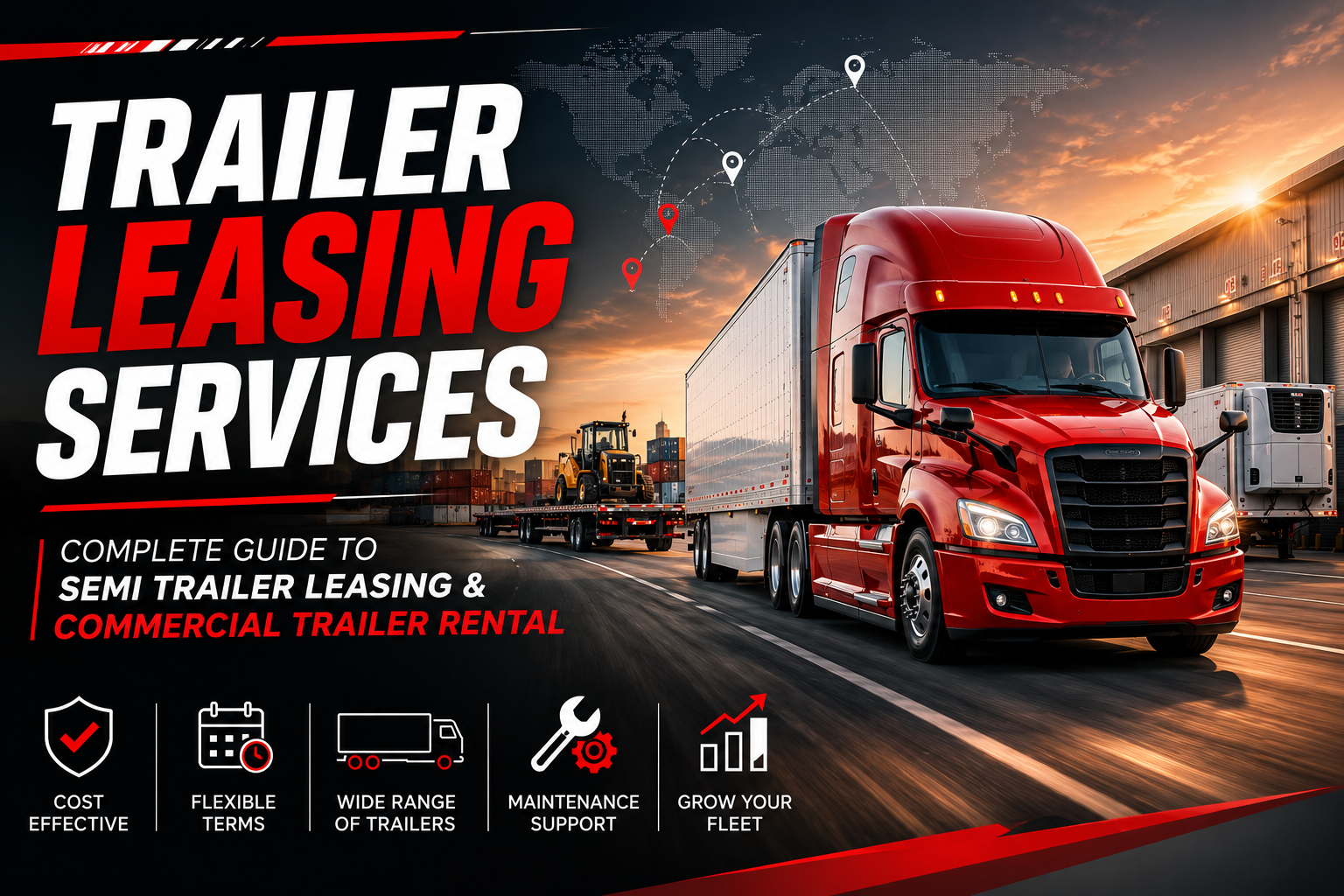
Trailer Leasing Services: Complete Guide to Semi Trailer Leasing & Commercial Trailer Rental (2026)
The trucking industry is constantly evolving, and businesses need flexible solutions to keep up with changing freight demands. Purchasing trailers outright isn’t always the most practical option, especially for startups, owner-operators, or companies managing seasonal workloads. This is where trailer leasing services provide a smart alternative.
Whether you’re transporting dry goods, refrigerated freight, construction materials, or oversized equipment, leasing allows businesses to expand their fleet without making a large capital investment. From semi trailer leasing to commercial trailer rental, companies can access the equipment they need while maintaining financial flexibility.
This guide explains everything you need to know about trailer leasing, including how it works, the benefits, available trailer types, costs, and how to choose reliable trailer renting companies.
Quick Answer
Trailer leasing services allow trucking companies, owner-operators, and commercial businesses to use trailers for a specified period without purchasing them outright. Leasing offers lower upfront costs, flexible contract terms, easier fleet expansion, and predictable monthly payments compared to buying a trailer. Businesses can choose from various trailer types, including dry vans, flatbeds, refrigerated trailers, tankers, and more, depending on operational requirements.
Key Takeaways
- Trailer leasing reduces large upfront equipment costs.
- Semi trailer leasing provides flexibility for growing fleets.
- Commercial trailer rental is ideal for temporary or seasonal transportation needs.
- Leasing helps businesses preserve working capital.
- Different trailer types are available for various freight requirements.
- Flexible lease terms make fleet management easier.
- Choosing an experienced trailer leasing provider ensures reliable equipment and professional support.
- Leasing can help businesses scale operations quickly without significant financial risk.
What Are Trailer Leasing Services?
Trailer leasing services allow businesses to use commercial trailers for a predetermined period while paying recurring lease payments instead of purchasing the equipment.
Unlike ownership, leasing provides access to modern trailers without requiring a significant upfront investment. Depending on business needs, lease agreements may range from a few months to several years.
Trailer leasing is widely used by:
- Owner-operators
- Small trucking businesses
- Medium-sized carriers
- Large transportation fleets
- Freight brokers
- Logistics companies
- Construction companies
- Agricultural businesses
- Distribution companies
Instead of tying up capital in expensive equipment purchases, businesses can allocate resources toward hiring drivers, expanding routes, maintaining vehicles, or improving operations.
What Is Trailer Leasing?
Trailer leasing is a financing arrangement where a leasing provider owns the trailer while allowing a customer to use it for an agreed period under specific lease terms.
During the lease, the customer pays monthly or scheduled lease payments. At the end of the agreement, options may include:
- Returning the trailer
- Renewing the lease
- Upgrading to newer equipment
- Purchasing the trailer (depending on the lease agreement)
This flexibility makes leasing attractive for businesses that frequently adjust fleet sizes or operate in changing market conditions.
Why Businesses Choose Trailer Leasing
Commercial transportation is highly competitive. Companies must balance operational efficiency with financial stability.
Purchasing multiple trailers often requires a substantial investment that can limit cash flow.
Trailer leasing helps businesses by:
Lower Initial Investment
Instead of spending tens of thousands of dollars on equipment, businesses pay manageable monthly lease payments.
Improved Cash Flow
Preserving capital allows companies to invest in other essential business areas such as hiring drivers, purchasing tractors, expanding routes, marketing, or technology.
Fleet Flexibility
Transportation demand changes throughout the year. Leasing enables companies to quickly increase or reduce fleet size based on seasonal demand.
Access to Modern Equipment
Many leasing providers regularly update their fleets, allowing businesses to operate newer trailers with improved safety features and reliability.
Easier Fleet Expansion
When new shipping contracts arise, leasing makes it easier to add trailers without waiting for equipment purchases or financing approvals.
How Semi Trailer Leasing Works
Semi trailer leasing follows a straightforward process designed to provide businesses with the equipment they need while minimizing financial strain.
The typical process includes:
Step 1: Determine Business Requirements
Before leasing, identify:
- Freight type
- Weight capacity
- Trailer dimensions
- Delivery routes
- Frequency of use
- Industry regulations
Choosing the correct trailer ensures maximum operational efficiency.
Step 2: Select the Trailer Type
Depending on your cargo, available options may include:
- Dry Van Trailers
- Refrigerated Trailers (Reefers)
- Flatbed Trailers
- Step Deck Trailers
- Lowboy Trailers
- Tank Trailers
- Dump Trailers
- Utility Trailers
- Gooseneck Trailers
Each trailer is designed for specific transportation needs.
Step 3: Choose Lease Duration
Trailer leasing companies generally offer:
Short-Term Leasing
Ideal for:
- Seasonal freight
- Temporary contracts
- Equipment testing
- Peak shipping periods
Long-Term Leasing
Suitable for:
- Growing fleets
- Regular freight operations
- Predictable transportation requirements
- Long-term business expansion
Step 4: Complete Documentation
Most leasing providers request business information such as:
- Company registration
- Business identification
- Insurance information
- Commercial driver’s licensing (where applicable)
- Financial documentation
- Credit evaluation (depending on lease type)
Requirements vary depending on the leasing provider.
Step 5: Begin Operations
Once the lease agreement is finalized, businesses can integrate the trailer into daily operations and begin transporting freight immediately.
Benefits of Trailer Leasing Services
Trailer leasing has become increasingly popular because it offers financial and operational advantages over purchasing equipment outright.
1. Reduced Capital Investment
Buying commercial trailers requires significant upfront costs.
Leasing spreads these expenses into predictable monthly payments, helping businesses preserve cash flow.
2. Faster Business Growth
Expanding a trucking fleet becomes much easier when companies can lease additional trailers instead of purchasing expensive equipment.
This flexibility supports rapid business growth and allows carriers to respond quickly to new opportunities.
3. Better Budget Planning
Fixed lease payments simplify financial forecasting and help businesses manage operating expenses more effectively.
Predictable costs make budgeting easier throughout the year.
4. Flexible Fleet Management
Freight demand fluctuates across industries.
Trailer leasing enables companies to:
- Add trailers during busy seasons.
- Reduce equipment during slower periods.
- Scale operations efficiently.
5. Access to Specialized Equipment
Different industries require specialized trailers.
Leasing provides access to:
- Refrigerated trailers
- Flatbeds
- Tankers
- Lowboys
- Step decks
- Dump trailers
without purchasing each type individually.
6. Lower Financial Risk
Equipment values can fluctuate over time.
Leasing reduces the financial risks associated with depreciation and resale, allowing businesses to focus on operations instead of equipment ownership.
7. Supports Business Flexibility
As customer requirements evolve, businesses can often upgrade or change trailer types at the end of a lease term, helping fleets adapt to changing transportation needs.
Commercial Trailer Rental vs. Trailer Leasing
Although the terms commercial trailer rental and trailer leasing are often used interchangeably, they serve different business needs. Understanding the distinction can help you choose the most cost-effective solution for your operation.
| Feature |
Trailer Leasing |
Commercial Trailer Rental |
| Duration |
Several months to multiple years |
Daily, weekly, or monthly |
| Best For |
Long-term business operations |
Temporary or seasonal projects |
| Monthly Cost |
Generally lower for long-term use |
Usually higher for extended periods |
| Flexibility |
Long-term agreements with renewal options |
Highly flexible, short-term commitments |
| Fleet Expansion |
Excellent |
Suitable for temporary increases |
| Equipment Availability |
Reserved for lease period |
Subject to availability |
When Should You Lease?
Trailer leasing is often the better option if you:
- Operate throughout the year.
- Need predictable monthly expenses.
- Plan to grow your trucking business.
- Regularly haul freight.
- Want consistent access to equipment.
When Is Commercial Trailer Rental Better?
Commercial trailer rental may be more suitable if you:
- Need equipment for a short-term project.
- Have seasonal transportation demands.
- Require a specialty trailer occasionally.
- Want to test a trailer before entering a lease agreement.
- Need emergency replacement equipment.
Both options have their advantages, and the right choice depends on your operational needs, budget, and long-term business goals.
Types of Commercial Trailers Available for Lease
Professional trailer leasing services typically offer a wide range of commercial trailers designed for different industries and freight types.
Dry Van Trailers
Dry van trailers are among the most commonly used trailers in the trucking industry.
Ideal for transporting:
- Packaged goods
- Consumer products
- Electronics
- Furniture
- General freight
They provide enclosed protection from weather and road conditions.
Refrigerated (Reefer) Trailers
Refrigerated trailers maintain controlled temperatures throughout transportation.
Commonly used for:
- Fresh produce
- Frozen food
- Pharmaceuticals
- Dairy products
- Floral products
These trailers are essential for temperature-sensitive cargo.
Flatbed Trailers
Flatbed trailers feature an open platform without walls or a roof.
Perfect for hauling:
- Construction materials
- Steel
- Lumber
- Machinery
- Heavy equipment
Loading and unloading are easier due to unrestricted access.
Step Deck Trailers
Step deck trailers offer a lower deck height than standard flatbeds.
They are commonly used for:
- Tall machinery
- Industrial equipment
- Agricultural equipment
- Oversized cargo
These trailers help accommodate freight that exceeds standard height limits.
Lowboy Trailers
Lowboy trailers are specifically designed for transporting extremely heavy or oversized loads.
Common applications include:
- Excavators
- Bulldozers
- Cranes
- Industrial equipment
- Mining machinery
Tank Trailers
Tank trailers transport liquid and bulk materials.
They are widely used for:
- Fuel
- Chemicals
- Food-grade liquids
- Water
- Agricultural products
Dump Trailers
Dump trailers are popular within construction and landscaping industries.
Common cargo includes:
- Gravel
- Sand
- Soil
- Demolition debris
- Construction waste
Utility Trailers
Utility trailers provide flexible transportation for lighter commercial loads.
Frequently used by:
- Contractors
- Landscapers
- Small businesses
- Equipment transport companies
Gooseneck Trailers
Gooseneck trailers offer improved stability and weight distribution.
Ideal for:
- Agricultural equipment
- Livestock
- Heavy machinery
- Construction equipment
Who Can Benefit from Trailer Leasing Services?
Trailer leasing is beneficial for businesses of all sizes across multiple industries.
Owner-Operators
Independent drivers often lease trailers to reduce startup costs while maintaining flexibility as their businesses grow.
Small Trucking Companies
Small carriers can expand operations without investing large amounts of capital in new equipment.
Large Fleet Operators
Established fleets often lease additional trailers to meet increased customer demand or replace aging equipment.
Freight Brokers
Freight brokers working with dedicated transportation providers may benefit from flexible trailer leasing arrangements to meet client requirements.
Construction Companies
Construction businesses frequently lease specialized trailers for transporting heavy equipment and building materials.
Agriculture Businesses
Farmers and agricultural companies often lease trailers during harvesting seasons when transportation demand increases.
Manufacturing Companies
Manufacturers moving raw materials and finished products may use leased trailers to improve supply chain efficiency.
Logistics Companies
Third-party logistics providers (3PLs) often rely on trailer leasing to support warehousing and transportation operations.
How to Choose the Right Trailer Leasing Company
Not all trailer renting companies provide the same level of service. Selecting a reliable leasing provider can help reduce downtime and improve operational efficiency.
Fleet Quality
Inspect the condition and age of available trailers.
Well-maintained equipment minimizes breakdowns and delivery delays.
Variety of Trailer Options
Choose providers offering multiple trailer types so your business can adapt as transportation needs change.
Flexible Lease Terms
A quality leasing provider should offer flexible agreements based on your business requirements.
Look for:
- Short-term leases
- Long-term leases
- Seasonal leasing
- Fleet expansion options
Maintenance Support
Some leasing providers include maintenance services within their lease agreements.
This can help reduce repair expenses and keep equipment operating efficiently.
Nationwide Availability
If your company operates across multiple states, consider providers offering nationwide trailer availability and support.
Transparent Pricing
Understand exactly what is included in the lease agreement.
Ask about:
- Monthly lease payments
- Maintenance costs
- Insurance requirements
- Early termination fees
- Mileage limitations (if applicable)
- Damage policies
Customer Support
Responsive customer service is essential when equipment issues arise.
Choose companies known for reliable support and quick problem resolution.
Documents Commonly Required for Trailer Leasing
Although requirements vary between providers, businesses are often asked to provide:
- Business registration documents
- Government-issued identification
- USDOT Number (if applicable)
- MC Number (if applicable)
- Proof of insurance
- Business address
- Financial information
- Credit references (for some lease agreements)
Preparing documentation in advance can help speed up the leasing process.
Common Mistakes to Avoid When Leasing a Trailer
Many businesses make avoidable mistakes when selecting trailer leasing services.
Choosing Based Only on Price
The lowest monthly payment may not always provide the best overall value.
Consider equipment quality, maintenance, and customer support.
Selecting the Wrong Trailer Type
Choosing equipment that doesn’t match your freight can reduce efficiency and increase operating costs.
Ignoring Lease Terms
Always review the agreement carefully before signing.
Pay attention to:
- Lease duration
- Payment schedule
- Maintenance responsibilities
- Return conditions
- Insurance obligations
Not Planning for Future Growth
Consider whether your business may require additional trailers in the coming years.
Working with a provider that supports fleet expansion can save time later.
Skipping Equipment Inspection
Inspect the trailer before accepting delivery.
Document any existing damage and confirm that all safety systems are functioning properly.
Cost Factors That Influence Trailer Leasing
Trailer leasing costs vary depending on several factors, including:
- Trailer type
- Trailer size
- Lease duration
- Equipment age
- Maintenance coverage
- Market demand
- Geographic location
- Insurance requirements
- Fleet size
Request detailed quotes from multiple providers to compare pricing and services before making a decision.
Frequently Asked Questions (FAQs)
1. What are trailer leasing services?
Trailer leasing services allow businesses to use commercial trailers for a fixed period by paying recurring lease payments instead of purchasing the equipment outright. Leasing helps businesses access the trailers they need while preserving capital and maintaining operational flexibility.
2. What is semi trailer leasing?
Semi trailer leasing is an agreement that allows trucking companies and owner-operators to lease semi trailers for short-term or long-term use. It provides access to commercial equipment without the high upfront cost of ownership.
3. Is trailer leasing better than buying?
It depends on your business goals. Leasing is often beneficial for companies seeking lower upfront costs, predictable monthly expenses, and the flexibility to upgrade equipment. Purchasing may be preferable for businesses planning long-term ownership and willing to manage maintenance and depreciation.
4. What is the difference between trailer leasing and commercial trailer rental?
Trailer leasing generally involves longer-term agreements, while commercial trailer rental is intended for short-term or temporary needs. Leasing is commonly used for ongoing operations, whereas rentals are suitable for seasonal demand or short projects.
5. What types of trailers are available for lease?
Many trailer leasing providers offer:
- Dry Van Trailers
- Flatbed Trailers
- Refrigerated (Reefer) Trailers
- Step Deck Trailers
- Lowboy Trailers
- Tank Trailers
- Dump Trailers
- Utility Trailers
- Gooseneck Trailers
Availability may vary by provider.
6. Who should consider trailer leasing?
Trailer leasing is suitable for:
- Owner-operators
- Small trucking companies
- Large commercial fleets
- Freight carriers
- Logistics providers
- Construction businesses
- Agricultural companies
- Manufacturing businesses
7. How long can I lease a trailer?
Lease terms vary by provider. Some companies offer short-term leases lasting a few months, while others provide long-term agreements that extend for several years.
8. Are maintenance services included with trailer leasing?
Some leasing companies include maintenance and repair services in their agreements, while others require customers to handle maintenance separately. Always review the lease terms to understand your responsibilities.
9. Can I lease multiple trailers for my fleet?
Yes. Many trailer leasing companies support fleet expansion by allowing businesses to lease multiple trailers based on their operational requirements and available inventory.
10. What documents are commonly required for trailer leasing?
Requirements vary but may include:
- Business registration documents
- Proof of insurance
- Government-issued identification
- USDOT Number (if applicable)
- MC Number (if applicable)
- Financial or credit information
Check with your leasing provider for specific documentation requirements.
11. Can owner-operators lease trailers?
Yes. Many leasing companies provide trailer leasing options specifically designed for independent owner-operators who want to expand their business without purchasing equipment.
12. Is commercial trailer rental available for short-term projects?
Yes. Commercial trailer rental is often the preferred option for businesses that need equipment for seasonal work, temporary contracts, or emergency transportation needs.
13. How do I choose the right trailer leasing company?
When comparing trailer leasing providers, consider:
- Equipment quality
- Lease flexibility
- Maintenance support
- Pricing transparency
- Customer service
- Fleet availability
- Industry reputation
14. Can I upgrade my leased trailer?
Some lease agreements allow customers to upgrade equipment at the end of the lease term or under specific conditions. Review your lease agreement for available options.
15. Are leased trailers suitable for interstate trucking?
Yes, provided the trailer complies with applicable federal and state regulations and is properly maintained for commercial use.
Conclusion
Selecting the right trailer leasing services can help trucking businesses improve operational efficiency, preserve working capital, and adapt to changing transportation demands. Whether you’re an independent owner-operator, a growing carrier, or a large logistics company, leasing offers a flexible way to access the equipment needed without the financial commitment of purchasing trailers outright.
From semi trailer leasing for long-term fleet expansion to commercial trailer rental for temporary transportation needs, businesses have multiple options to support their operations. Choosing a reputable provider, understanding lease terms, selecting the appropriate trailer type, and planning for future growth are all important factors when making leasing decisions.
If you’re looking for dependable trailer leasing solutions, JST Truck Permits can help you navigate the process and connect you with services that support your trucking business. With the right equipment and a reliable leasing strategy, you can keep your fleet moving efficiently while staying focused on delivering exceptional service to your customers.
Compliance Disclaimer
The information provided in this article is intended for general educational and informational purposes only. Trailer leasing agreements, equipment availability, pricing, maintenance responsibilities, and business requirements may vary by leasing provider and jurisdiction. Businesses should carefully review lease agreements and consult with qualified legal, financial, or transportation professionals before making leasing decisions. For specific assistance with trucking permits, registrations, or compliance requirements, contact JST Truck Permits.