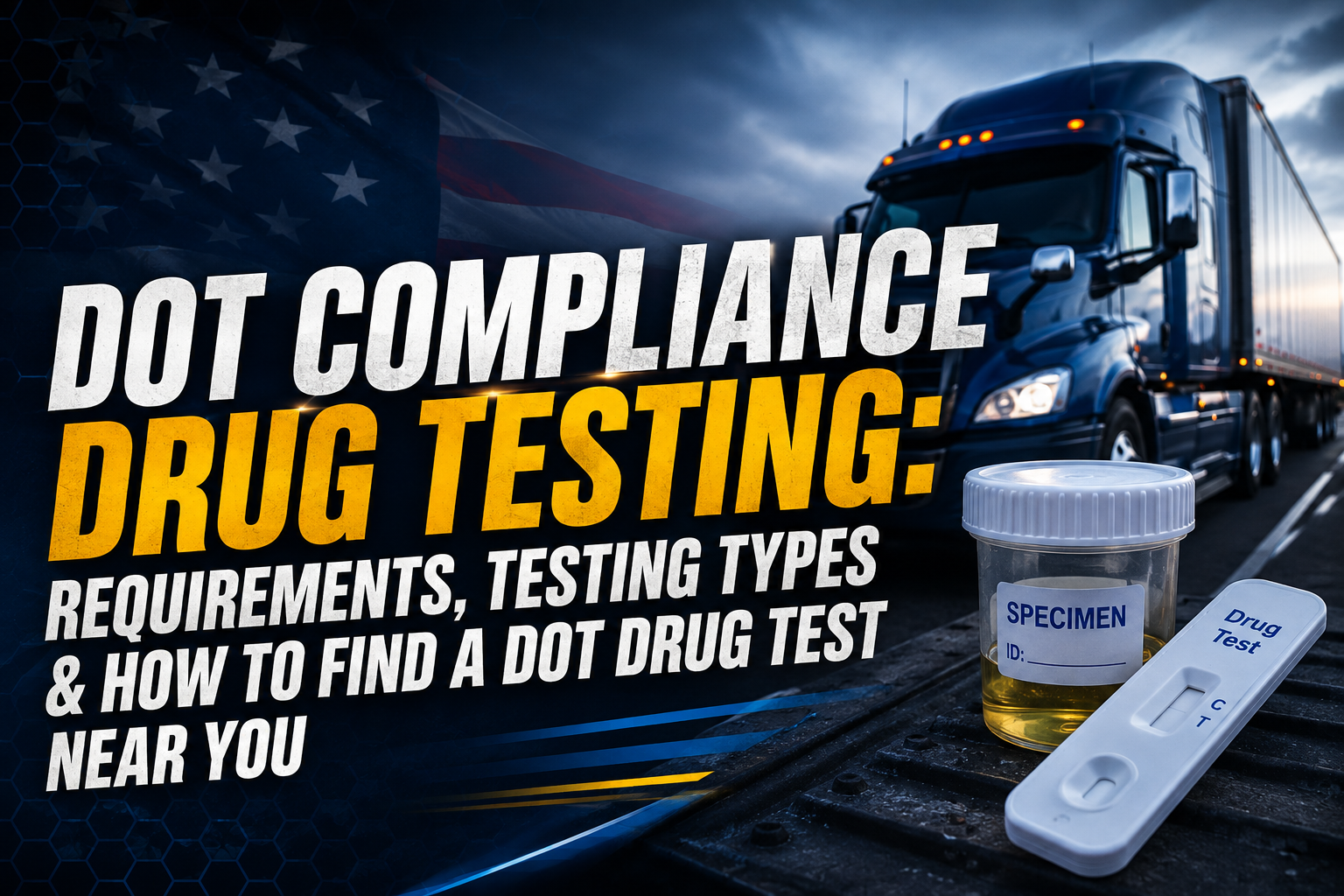
DOT Compliance Drug Testing: Requirements, Testing Types & How to Find a DOT Drug Test Near You
Drug and alcohol testing is an important safety and compliance responsibility for many transportation employers and commercial drivers in the United States. For trucking companies operating under applicable Department of Transportation (DOT) and Federal Motor Carrier Safety Administration (FMCSA) regulations, understanding testing requirements is essential.
DOT compliance drug testing is not the same as an ordinary workplace drug test. DOT-regulated testing follows specific federal procedures covering who must be tested, when testing is required, how specimens are collected, which substances are tested, and how results are reviewed and reported.
For CDL drivers and motor carriers, mistakes in a drug and alcohol testing program can create serious compliance issues. Employers should understand their responsibilities before placing drivers in safety-sensitive positions.
This guide explains DOT compliance drug testing, when tests may be required, what drivers should expect, and what to consider when searching fo
Drug and alcohol testing is an important safety and compliance responsibility for many transportation employers and commercial drivers in the United States. For trucking companies operating under applicable Department of Transportation (DOT) and Federal Motor Carrier Safety Administration (FMCSA) regulations, understanding testing requirements is essential.
DOT compliance drug testing is not the same as an ordinary workplace drug test. DOT-regulated testing follows specific federal procedures covering who must be tested, when testing is required, how specimens are collected, which substances are tested, and how results are reviewed and reported.
For CDL drivers and motor carriers, mistakes in a drug and alcohol testing program can create serious compliance issues. Employers should understand their responsibilities before placing drivers in safety-sensitive positions.
This guide explains DOT compliance drug testing, when tests may be required, what drivers should expect, and what to consider when searching for a DOT drug test near me or DOT certified drug testing services.
What Is DOT Compliance Drug Testing?
DOT compliance drug testing is federally regulated drug testing conducted for employees performing safety-sensitive transportation functions under applicable DOT agency regulations.
For interstate trucking and many commercial motor vehicle operations, FMCSA regulations establish drug and alcohol testing requirements for covered CDL drivers.
A compliant testing program involves more than simply sending a driver to a laboratory.
Depending on the situation, the process may involve:
- DOT-compliant specimen collection
- Required testing panels
- Chain-of-custody procedures
- Laboratory analysis
- Medical Review Officer review
- Employer documentation
- Random testing programs
- FMCSA Clearinghouse responsibilities
- Recordkeeping
Employers should ensure that each part of the testing process follows applicable DOT procedures.
Who Is Subject to DOT Drug Testing?
DOT drug and alcohol testing generally applies to employees who perform covered safety-sensitive transportation functions.
Within the trucking industry, this commonly includes drivers who are required to hold a Commercial Driver’s License or Commercial Learner’s Permit and who operate commercial motor vehicles subject to applicable FMCSA requirements.
Examples can include:
- Interstate commercial truck drivers
- Certain intrastate CDL drivers
- Drivers operating qualifying commercial motor vehicles
- Drivers transporting certain quantities of hazardous materials
- Other CDL holders performing applicable safety-sensitive functions
Employers should determine whether each driver’s duties fall under DOT and FMCSA testing requirements rather than assuming that every employee is subject to the same rules.
What Is a DOT Drug Test?
A DOT drug test follows procedures established under federal transportation regulations.
DOT-regulated drug testing currently screens for specified drug categories, including:
- Marijuana metabolites
- Cocaine metabolites
- Amphetamines
- Opioids
- Phencyclidine (PCP)
The testing process must follow DOT requirements for specimen collection, laboratory testing, documentation, and result review.
This standardized approach distinguishes DOT testing from many non-DOT workplace drug tests.
DOT Drug Testing vs Non-DOT Drug Testing
Although both tests may screen for drugs, they are not interchangeable.
| DOT Drug Testing |
Non-DOT Drug Testing |
| Governed by federal DOT procedures |
Based on employer or other applicable policies |
| Used for covered safety-sensitive transportation employees |
Can be used for many general workplaces |
| Uses federally prescribed procedures |
Procedures can vary |
| Requires appropriate chain-of-custody documentation |
Documentation requirements may differ |
| Results follow DOT review procedures |
Review processes vary |
| Subject to DOT recordkeeping requirements |
Recordkeeping depends on applicable policy/law |
If an employer needs a DOT-regulated test, an ordinary non-DOT test generally should not be substituted for it.
When Is DOT Compliance Drug Testing Required?
Different testing circumstances can apply throughout a driver’s employment.
1. Pre-Employment Testing
Before an employer permits a covered driver to perform a safety-sensitive function, applicable pre-employment drug-testing requirements must be satisfied.
This makes drug-testing compliance an important part of onboarding new CDL drivers.
Employers should complete required steps before allowing the driver to begin covered safety-sensitive work.
2. Random Testing
Covered drivers are generally subject to random drug and alcohol testing.
Random testing programs must follow applicable DOT and FMCSA selection and testing requirements.
The purpose of random testing is to ensure covered employees remain subject to unannounced testing throughout the year.
Carriers should not treat random testing as optional or wait until the end of the year to organize their program.
3. Post-Accident Testing
Certain commercial motor vehicle accidents may trigger DOT post-accident drug and/or alcohol testing requirements.
However, not every accident automatically requires DOT testing.
Employers need to understand the applicable criteria and required timeframes so they can determine when testing is necessary.
4. Reasonable Suspicion Testing
An employer may be required to test a driver when a properly trained supervisor observes specific signs that meet applicable reasonable-suspicion requirements.
Because these situations can be sensitive, supervisors responsible for making these determinations should receive appropriate training.
5. Return-to-Duty Testing
A driver who has violated applicable DOT drug or alcohol regulations generally cannot simply return to safety-sensitive work immediately.
The driver must complete the applicable return-to-duty process, which includes requirements involving a qualified Substance Abuse Professional and a return-to-duty test.
6. Follow-Up Testing
Following a return-to-duty process, a driver may also be subject to a follow-up testing plan.
Follow-up testing is separate from the employer’s regular random testing program and must be handled according to applicable requirements.
What Does “DOT Certified Drug Testing” Mean?
Many drivers search online for DOT certified drug testing when they need a test for a trucking job or compliance requirement.
However, the phrase should be used carefully.
DOT does not simply “certify” every local drug-testing business in the way the phrase might suggest.
A DOT-regulated drug test instead involves qualified service agents and processes that comply with federal requirements. This can include appropriate collection procedures, laboratories certified for federal workplace drug testing, Medical Review Officers, and required documentation.
Therefore, when searching for DOT certified drug testing, drivers and employers should verify that the provider actually performs DOT-regulated testing according to applicable federal procedures.
What Should You Look for in a DOT Drug Testing Provider?
Before scheduling a test, verify that the provider understands DOT requirements.
Ask whether the facility provides:
- DOT-regulated testing
- Appropriate federal custody and control documentation
- Collection according to DOT procedures
- Testing through an appropriate laboratory
- Medical Review Officer services
- Employer result reporting
- Support for applicable trucking-industry testing requirements
For trucking companies, choosing an appropriate provider helps prevent a situation where a driver completes a test that does not satisfy the intended DOT requirement.
Searching for a “DOT Drug Test Near Me”?
DOT drug test near me is one of the most common searches made by CDL drivers and trucking employers who need testing quickly.
Location matters, but proximity should not be the only consideration.
Before choosing a nearby collection site, verify:
Does the location perform DOT-regulated testing?
A facility may offer drug testing without providing the specific DOT-regulated service you need.
Does it accept CDL drivers?
Confirm that the collection site regularly handles DOT transportation testing.
Is an appointment required?
Some locations accept walk-ins, while others require appointments.
What documentation should you bring?
Drivers may need identification and employer or testing-program information.
How are results processed?
Understand how results will be reviewed and transmitted to the appropriate employer or program administrator.
A nearby facility is useful only if it provides the correct testing service.
DOT Drug Testing for Owner-Operators
Owner-operators sometimes assume drug-testing requirements apply only to larger trucking companies.
That is not necessarily the case.
An owner-operator who is subject to FMCSA drug and alcohol testing requirements generally needs an appropriate mechanism for participating in the required testing program.
This commonly involves participation in a consortium/third-party administrator, often called a C/TPA, for applicable random testing responsibilities.
Owner-operators should also understand their responsibilities involving the FMCSA Drug & Alcohol Clearinghouse.
Operating one truck does not automatically eliminate federal testing responsibilities.
DOT Drug Testing for Trucking Fleets
As a fleet grows, managing drug and alcohol compliance becomes more complex.
A trucking company may need to coordinate:
- New driver testing
- Random selections
- Collection appointments
- Supervisor training
- Post-accident procedures
- Driver records
- Clearinghouse responsibilities
- Return-to-duty situations
- Follow-up testing
- Compliance documentation
Having a written process can help fleet managers respond consistently rather than deciding what to do only after an incident occurs.
FMCSA Drug & Alcohol Clearinghouse
The FMCSA Drug & Alcohol Clearinghouse is an important component of drug and alcohol compliance for covered CDL drivers and employers.
It is a secure online database containing records of violations of FMCSA’s drug and alcohol testing program requirements and information concerning applicable return-to-duty processes.
Employers have specific Clearinghouse responsibilities that can include queries and reporting obligations.
Motor carriers should understand these responsibilities as part of their broader DOT compliance drug testing program.
Why Recordkeeping Matters
Completing a drug test is only one part of compliance.
Employers must also maintain applicable records.
Depending on the requirement, documentation may relate to:
- Testing results
- Random selections
- Testing notifications
- Collection records
- Supervisor training
- Employee education
- Program policies
- Return-to-duty procedures
- Follow-up testing
- Clearinghouse actions
Records should be stored securely and retained for applicable periods.
A strong compliance program makes documentation easy to retrieve when needed.
Common DOT Drug Testing Compliance Mistakes
Using a Non-DOT Test
A general workplace drug test should not be assumed to satisfy a DOT testing requirement.
Missing Pre-Employment Requirements
Covered drivers should not begin applicable safety-sensitive functions before required pre-employment procedures are satisfied.
Poor Random Testing Management
Random testing should follow applicable selection, timing, and documentation requirements.
Not Understanding Post-Accident Rules
Not every accident triggers the same testing requirements. Employers need a procedure for quickly determining what applies.
Incomplete Recordkeeping
A test may have occurred, but poor documentation can still create problems during a compliance review.
Ignoring Clearinghouse Responsibilities
Drug-testing compliance and applicable Clearinghouse responsibilities should be managed together.
Assuming Owner-Operators Are Exempt
Single-truck operations can still be subject to applicable FMCSA drug and alcohol testing requirements.
How to Build a Better DOT Compliance Drug Testing Program
Trucking companies can improve their compliance processes by creating a structured system.
Step 1: Identify Covered Drivers
Determine which employees perform DOT-regulated safety-sensitive functions.
Step 2: Establish a Compliant Testing Program
Make sure appropriate testing procedures and service providers are in place.
Step 3: Create Written Procedures
Document how your company handles pre-employment, random, post-accident, reasonable-suspicion, return-to-duty, and follow-up situations.
Step 4: Train Appropriate Supervisors
Ensure supervisors responsible for reasonable-suspicion decisions receive required training.
Step 5: Maintain Records
Create a secure system for storing testing and compliance documentation.
Step 6: Manage Clearinghouse Responsibilities
Understand applicable employer query and reporting requirements.
Step 7: Review the Program Regularly
Compliance should be reviewed throughout the year, not only when an audit occurs.
Why DOT Compliance Drug Testing Matters for New Trucking Companies
New trucking businesses have many responsibilities to manage simultaneously.
These can include:
- USDOT registration
- Operating authority
- Insurance
- BOC-3
- UCR
- IRP
- IFTA
- Driver qualification
- Vehicle maintenance
- Drug and alcohol testing
Drug-testing compliance should not be left until after drivers have already begun operating.
Establishing the correct program during the company setup process helps create a stronger compliance foundation.
DOT Compliance Drug Testing Checklist
Before putting a covered CDL driver into a safety-sensitive role, review your program.
- Confirm whether the driver is covered by DOT/FMCSA testing regulations.
- Complete applicable pre-employment requirements.
- Maintain a compliant random testing program.
- Understand post-accident testing criteria.
- Train supervisors where required.
- Establish reasonable-suspicion procedures.
- Understand return-to-duty requirements.
- Maintain applicable follow-up testing procedures.
- Complete applicable Clearinghouse responsibilities.
- Maintain required records.
- Periodically review your compliance program.
How JST Truck Permits Can Help
Managing drug-testing compliance while operating a trucking business can become time-consuming, particularly for new carriers and growing fleets.
JST Truck Permits helps owner-operators and trucking companies navigate trucking registration, permit, and compliance-related responsibilities.
Our services include support involving:
- DOT drug testing
- Drug and alcohol compliance
- New trucking company setup
- USDOT registration
- FMCSA registration
- MC Authority
- DOT safety audit support
- Driver compliance
- Trucking permits
- IRP
- IFTA
- UCR
- Fleet permit management
Our goal is to help carriers create more organized compliance processes while they focus on operating and growing their trucking businesses.
Frequently Asked Questions
What is DOT compliance drug testing?
DOT compliance drug testing is testing conducted according to applicable U.S. Department of Transportation regulations for covered employees performing safety-sensitive transportation functions.
Where can I find a DOT drug test near me?
When searching for a DOT drug test near me, look for a collection site that specifically performs DOT-regulated testing. Confirm the service before scheduling because not every drug-testing facility provides DOT testing.
Is a regular drug test the same as a DOT drug test?
No. DOT-regulated testing follows specific federal procedures concerning specimen collection, laboratory testing, documentation, review, and reporting.
What is DOT certified drug testing?
DOT certified drug testing is a commonly searched phrase for testing that complies with DOT requirements. Rather than relying solely on the word “certified,” verify that the provider follows applicable DOT procedures and uses appropriate qualified service agents and laboratories.
Do owner-operators need DOT drug testing?
Owner-operators subject to FMCSA drug and alcohol testing requirements generally must participate in an appropriate testing program and comply with applicable Clearinghouse requirements.
Is pre-employment drug testing required for CDL drivers?
Covered CDL drivers generally must receive a negative pre-employment controlled-substances test result before performing applicable safety-sensitive functions, subject to the relevant regulations and exceptions.
Are CDL drivers randomly drug tested?
Covered drivers are generally included in applicable random drug and alcohol testing programs.
Does every truck accident require a DOT drug test?
No. DOT post-accident testing requirements depend on specific regulatory criteria. Employers should evaluate each accident against applicable FMCSA requirements.
Final Thoughts
DOT compliance drug testing is not simply about passing a drug test. It is an ongoing compliance process involving appropriate testing, qualified service providers, accurate documentation, random testing, Clearinghouse responsibilities, and employer oversight.
Whether you’re an owner-operator or managing a large commercial fleet, understanding the rules before a testing situation occurs can help you avoid unnecessary compliance problems.
If you’re searching for a DOT drug test near me, make sure the facility provides the specific DOT-regulated testing required for your situation rather than choosing a provider based only on location.
Likewise, when searching for DOT certified drug testing, verify the provider’s DOT procedures instead of relying only on marketing terminology.
For trucking businesses, the most effective approach is simple:
Understand the requirements. Establish the correct program. Document everything. Review compliance regularly.
JST Truck Permits can assist trucking companies with DOT drug testing support and broader trucking registration and compliance services.
services.
What Is DOT Compliance Drug Testing?
DOT compliance drug testing is federally regulated drug testing conducted for employees performing safety-sensitive transportation functions under applicable DOT agency regulations.
For interstate trucking and many commercial motor vehicle operations, FMCSA regulations establish drug and alcohol testing requirements for covered CDL drivers.
A compliant testing program involves more than simply sending a driver to a laboratory.
Depending on the situation, the process may involve:
- DOT-compliant specimen collection
- Required testing panels
- Chain-of-custody procedures
- Laboratory analysis
- Medical Review Officer review
- Employer documentation
- Random testing programs
- FMCSA Clearinghouse responsibilities
- Recordkeeping
Employers should ensure that each part of the testing process follows applicable DOT procedures.
Who Is Subject to DOT Drug Testing?
DOT drug and alcohol testing generally applies to employees who perform covered safety-sensitive transportation functions.
Within the trucking industry, this commonly includes drivers who are required to hold a Commercial Driver’s License or Commercial Learner’s Permit and who operate commercial motor vehicles subject to applicable FMCSA requirements.
Examples can include:
- Interstate commercial truck drivers
- Certain intrastate CDL drivers
- Drivers operating qualifying commercial motor vehicles
- Drivers transporting certain quantities of hazardous materials
- Other CDL holders performing applicable safety-sensitive functions
Employers should determine whether each driver’s duties fall under DOT and FMCSA testing requirements rather than assuming that every employee is subject to the same rules.
What Is a DOT Drug Test?
A DOT drug test follows procedures established under federal transportation regulations.
DOT-regulated drug testing currently screens for specified drug categories, including:
- Marijuana metabolites
- Cocaine metabolites
- Amphetamines
- Opioids
- Phencyclidine (PCP)
The testing process must follow DOT requirements for specimen collection, laboratory testing, documentation, and result review.
This standardized approach distinguishes DOT testing from many non-DOT workplace drug tests.
DOT Drug Testing vs Non-DOT Drug Testing
Although both tests may screen for drugs, they are not interchangeable.
| DOT Drug Testing |
Non-DOT Drug Testing |
| Governed by federal DOT procedures |
Based on employer or other applicable policies |
| Used for covered safety-sensitive transportation employees |
Can be used for many general workplaces |
| Uses federally prescribed procedures |
Procedures can vary |
| Requires appropriate chain-of-custody documentation |
Documentation requirements may differ |
| Results follow DOT review procedures |
Review processes vary |
| Subject to DOT recordkeeping requirements |
Recordkeeping depends on applicable policy/law |
If an employer needs a DOT-regulated test, an ordinary non-DOT test generally should not be substituted for it.
When Is DOT Compliance Drug Testing Required?
Different testing circumstances can apply throughout a driver’s employment.
1. Pre-Employment Testing
Before an employer permits a covered driver to perform a safety-sensitive function, applicable pre-employment drug-testing requirements must be satisfied.
This makes drug-testing compliance an important part of onboarding new CDL drivers.
Employers should complete required steps before allowing the driver to begin covered safety-sensitive work.
2. Random Testing
Covered drivers are generally subject to random drug and alcohol testing.
Random testing programs must follow applicable DOT and FMCSA selection and testing requirements.
The purpose of random testing is to ensure covered employees remain subject to unannounced testing throughout the year.
Carriers should not treat random testing as optional or wait until the end of the year to organize their program.
3. Post-Accident Testing
Certain commercial motor vehicle accidents may trigger DOT post-accident drug and/or alcohol testing requirements.
However, not every accident automatically requires DOT testing.
Employers need to understand the applicable criteria and required timeframes so they can determine when testing is necessary.
4. Reasonable Suspicion Testing
An employer may be required to test a driver when a properly trained supervisor observes specific signs that meet applicable reasonable-suspicion requirements.
Because these situations can be sensitive, supervisors responsible for making these determinations should receive appropriate training.
5. Return-to-Duty Testing
A driver who has violated applicable DOT drug or alcohol regulations generally cannot simply return to safety-sensitive work immediately.
The driver must complete the applicable return-to-duty process, which includes requirements involving a qualified Substance Abuse Professional and a return-to-duty test.
6. Follow-Up Testing
Following a return-to-duty process, a driver may also be subject to a follow-up testing plan.
Follow-up testing is separate from the employer’s regular random testing program and must be handled according to applicable requirements.
What Does “DOT Certified Drug Testing” Mean?
Many drivers search online for DOT certified drug testing when they need a test for a trucking job or compliance requirement.
However, the phrase should be used carefully.
DOT does not simply “certify” every local drug-testing business in the way the phrase might suggest.
A DOT-regulated drug test instead involves qualified service agents and processes that comply with federal requirements. This can include appropriate collection procedures, laboratories certified for federal workplace drug testing, Medical Review Officers, and required documentation.
Therefore, when searching for DOT certified drug testing, drivers and employers should verify that the provider actually performs DOT-regulated testing according to applicable federal procedures.
What Should You Look for in a DOT Drug Testing Provider?
Before scheduling a test, verify that the provider understands DOT requirements.
Ask whether the facility provides:
- DOT-regulated testing
- Appropriate federal custody and control documentation
- Collection according to DOT procedures
- Testing through an appropriate laboratory
- Medical Review Officer services
- Employer result reporting
- Support for applicable trucking-industry testing requirements
For trucking companies, choosing an appropriate provider helps prevent a situation where a driver completes a test that does not satisfy the intended DOT requirement.
Searching for a “DOT Drug Test Near Me”?
DOT drug test near me is one of the most common searches made by CDL drivers and trucking employers who need testing quickly.
Location matters, but proximity should not be the only consideration.
Before choosing a nearby collection site, verify:
Does the location perform DOT-regulated testing?
A facility may offer drug testing without providing the specific DOT-regulated service you need.
Does it accept CDL drivers?
Confirm that the collection site regularly handles DOT transportation testing.
Is an appointment required?
Some locations accept walk-ins, while others require appointments.
What documentation should you bring?
Drivers may need identification and employer or testing-program information.
How are results processed?
Understand how results will be reviewed and transmitted to the appropriate employer or program administrator.
A nearby facility is useful only if it provides the correct testing service.
DOT Drug Testing for Owner-Operators
Owner-operators sometimes assume drug-testing requirements apply only to larger trucking companies.
That is not necessarily the case.
An owner-operator who is subject to FMCSA drug and alcohol testing requirements generally needs an appropriate mechanism for participating in the required testing program.
This commonly involves participation in a consortium/third-party administrator, often called a C/TPA, for applicable random testing responsibilities.
Owner-operators should also understand their responsibilities involving the FMCSA Drug & Alcohol Clearinghouse.
Operating one truck does not automatically eliminate federal testing responsibilities.
DOT Drug Testing for Trucking Fleets
As a fleet grows, managing drug and alcohol compliance becomes more complex.
A trucking company may need to coordinate:
- New driver testing
- Random selections
- Collection appointments
- Supervisor training
- Post-accident procedures
- Driver records
- Clearinghouse responsibilities
- Return-to-duty situations
- Follow-up testing
- Compliance documentation
Having a written process can help fleet managers respond consistently rather than deciding what to do only after an incident occurs.
FMCSA Drug & Alcohol Clearinghouse
The FMCSA Drug & Alcohol Clearinghouse is an important component of drug and alcohol compliance for covered CDL drivers and employers.
It is a secure online database containing records of violations of FMCSA’s drug and alcohol testing program requirements and information concerning applicable return-to-duty processes.
Employers have specific Clearinghouse responsibilities that can include queries and reporting obligations.
Motor carriers should understand these responsibilities as part of their broader DOT compliance drug testing program.
Why Recordkeeping Matters
Completing a drug test is only one part of compliance.
Employers must also maintain applicable records.
Depending on the requirement, documentation may relate to:
- Testing results
- Random selections
- Testing notifications
- Collection records
- Supervisor training
- Employee education
- Program policies
- Return-to-duty procedures
- Follow-up testing
- Clearinghouse actions
Records should be stored securely and retained for applicable periods.
A strong compliance program makes documentation easy to retrieve when needed.
Common DOT Drug Testing Compliance Mistakes
Using a Non-DOT Test
A general workplace drug test should not be assumed to satisfy a DOT testing requirement.
Missing Pre-Employment Requirements
Covered drivers should not begin applicable safety-sensitive functions before required pre-employment procedures are satisfied.
Poor Random Testing Management
Random testing should follow applicable selection, timing, and documentation requirements.
Not Understanding Post-Accident Rules
Not every accident triggers the same testing requirements. Employers need a procedure for quickly determining what applies.
Incomplete Recordkeeping
A test may have occurred, but poor documentation can still create problems during a compliance review.
Ignoring Clearinghouse Responsibilities
Drug-testing compliance and applicable Clearinghouse responsibilities should be managed together.
Assuming Owner-Operators Are Exempt
Single-truck operations can still be subject to applicable FMCSA drug and alcohol testing requirements.
How to Build a Better DOT Compliance Drug Testing Program
Trucking companies can improve their compliance processes by creating a structured system.
Step 1: Identify Covered Drivers
Determine which employees perform DOT-regulated safety-sensitive functions.
Step 2: Establish a Compliant Testing Program
Make sure appropriate testing procedures and service providers are in place.
Step 3: Create Written Procedures
Document how your company handles pre-employment, random, post-accident, reasonable-suspicion, return-to-duty, and follow-up situations.
Step 4: Train Appropriate Supervisors
Ensure supervisors responsible for reasonable-suspicion decisions receive required training.
Step 5: Maintain Records
Create a secure system for storing testing and compliance documentation.
Step 6: Manage Clearinghouse Responsibilities
Understand applicable employer query and reporting requirements.
Step 7: Review the Program Regularly
Compliance should be reviewed throughout the year, not only when an audit occurs.
Why DOT Compliance Drug Testing Matters for New Trucking Companies
New trucking businesses have many responsibilities to manage simultaneously.
These can include:
- USDOT registration
- Operating authority
- Insurance
- BOC-3
- UCR
- IRP
- IFTA
- Driver qualification
- Vehicle maintenance
- Drug and alcohol testing
Drug-testing compliance should not be left until after drivers have already begun operating.
Establishing the correct program during the company setup process helps create a stronger compliance foundation.
DOT Compliance Drug Testing Checklist
Before putting a covered CDL driver into a safety-sensitive role, review your program.
- Confirm whether the driver is covered by DOT/FMCSA testing regulations.
- Complete applicable pre-employment requirements.
- Maintain a compliant random testing program.
- Understand post-accident testing criteria.
- Train supervisors where required.
- Establish reasonable-suspicion procedures.
- Understand return-to-duty requirements.
- Maintain applicable follow-up testing procedures.
- Complete applicable Clearinghouse responsibilities.
- Maintain required records.
- Periodically review your compliance program.
How JST Truck Permits Can Help
Managing drug-testing compliance while operating a trucking business can become time-consuming, particularly for new carriers and growing fleets.
JST Truck Permits helps owner-operators and trucking companies navigate trucking registration, permit, and compliance-related responsibilities.
Our services include support involving:
- DOT drug testing
- Drug and alcohol compliance
- New trucking company setup
- USDOT registration
- FMCSA registration
- MC Authority
- DOT safety audit support
- Driver compliance
- Trucking permits
- IRP
- IFTA
- UCR
- Fleet permit management
Our goal is to help carriers create more organized compliance processes while they focus on operating and growing their trucking businesses.
Frequently Asked Questions
What is DOT compliance drug testing?
DOT compliance drug testing is testing conducted according to applicable U.S. Department of Transportation regulations for covered employees performing safety-sensitive transportation functions.
Where can I find a DOT drug test near me?
When searching for a DOT drug test near me, look for a collection site that specifically performs DOT-regulated testing. Confirm the service before scheduling because not every drug-testing facility provides DOT testing.
Is a regular drug test the same as a DOT drug test?
No. DOT-regulated testing follows specific federal procedures concerning specimen collection, laboratory testing, documentation, review, and reporting.
What is DOT certified drug testing?
DOT certified drug testing is a commonly searched phrase for testing that complies with DOT requirements. Rather than relying solely on the word “certified,” verify that the provider follows applicable DOT procedures and uses appropriate qualified service agents and laboratories.
Do owner-operators need DOT drug testing?
Owner-operators subject to FMCSA drug and alcohol testing requirements generally must participate in an appropriate testing program and comply with applicable Clearinghouse requirements.
Is pre-employment drug testing required for CDL drivers?
Covered CDL drivers generally must receive a negative pre-employment controlled-substances test result before performing applicable safety-sensitive functions, subject to the relevant regulations and exceptions.
Are CDL drivers randomly drug tested?
Covered drivers are generally included in applicable random drug and alcohol testing programs.
Does every truck accident require a DOT drug test?
No. DOT post-accident testing requirements depend on specific regulatory criteria. Employers should evaluate each accident against applicable FMCSA requirements.
Final Thoughts
DOT compliance drug testing is not simply about passing a drug test. It is an ongoing compliance process involving appropriate testing, qualified service providers, accurate documentation, random testing, Clearinghouse responsibilities, and employer oversight.
Whether you’re an owner-operator or managing a large commercial fleet, understanding the rules before a testing situation occurs can help you avoid unnecessary compliance problems.
If you’re searching for a DOT drug test near me, make sure the facility provides the specific DOT-regulated testing required for your situation rather than choosing a provider based only on location.
Likewise, when searching for DOT certified drug testing, verify the provider’s DOT procedures instead of relying only on marketing terminology.
For trucking businesses, the most effective approach is simple:
Understand the requirements. Establish the correct program. Document everything. Review compliance regularly.
JST Truck Permits can assist trucking companies with DOT drug testing support and broader trucking registration and compliance services.