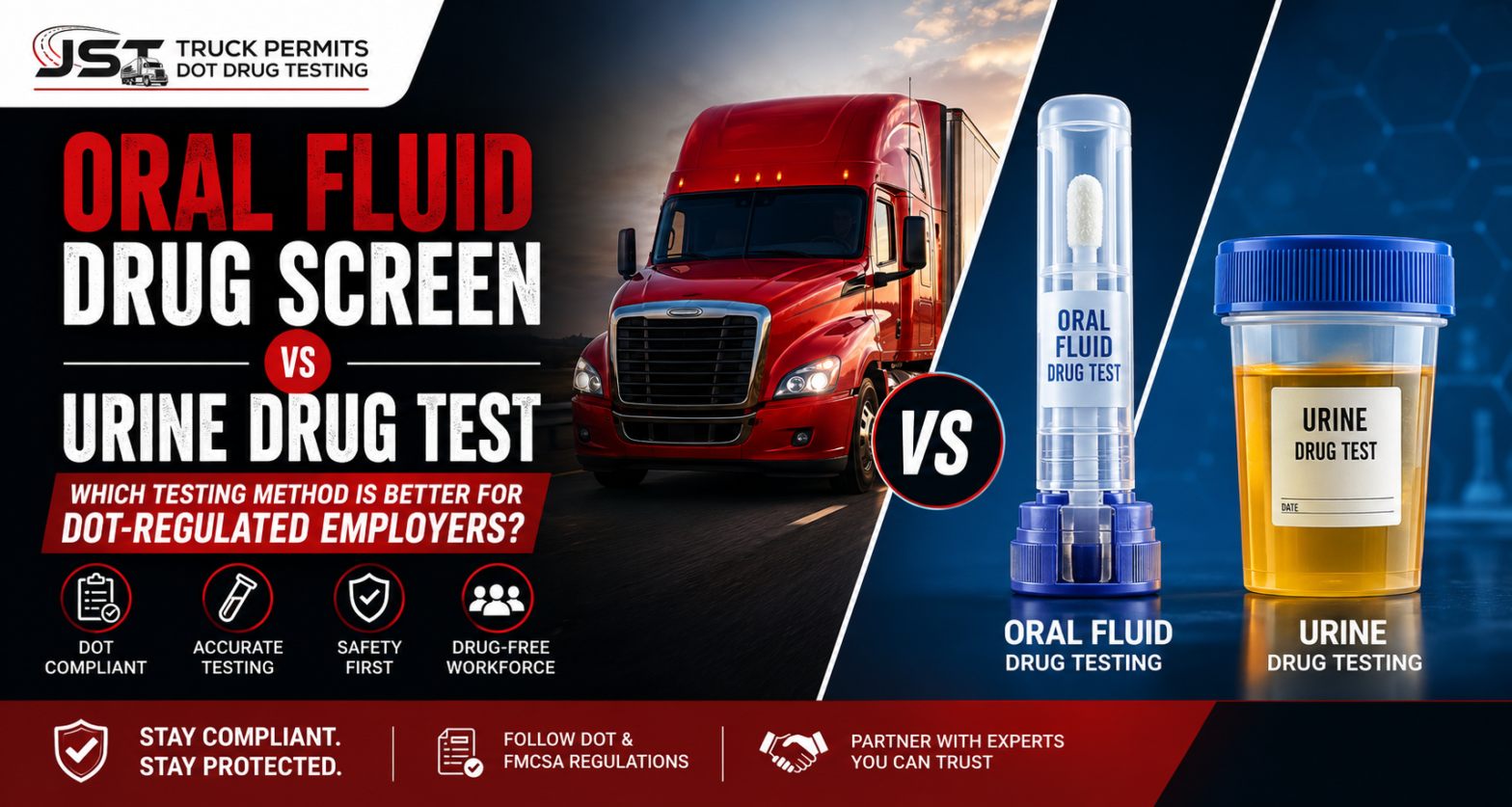
Oral Fluid Drug Screen vs Urine Drug Test: Which Testing Method Is Better for DOT-Regulated Employers?
Drug testing is an important part of maintaining safety and regulatory compliance in the commercial transportation industry. For trucking companies, fleet operators, and other DOT-regulated employers, choosing and administering the correct testing method requires an understanding of federal rules as well as the practical differences between specimen types.
Urine testing has long been the standard method used in federally regulated workplace drug-testing programs. However, oral fluid drug testing has received significant attention because collection is directly observed and oral fluid can be useful for identifying comparatively recent drug use.
That raises an important question for transportation employers:
How does an oral fluid drug screen compare with a urine drug test, and when can DOT-regulated employers actually use oral fluid testing?
This guide compares oral fluid drug testing, oral fluid testing, DOT oral fluid testing, and traditional urine testing, with a particular focus on trucking companies and FMCSA-regulated employers.
Important: DOT drug-testing rules and implementation details can change. Employers should verify current requirements with the U.S. Department of Transportation and the applicable DOT agency before changing their testing program.
Quick Answer
An oral fluid drug screen analyzes a saliva/oral-fluid specimen collected from inside a person’s mouth, while a urine drug test analyzes a urine specimen. Oral-fluid collection is directly observed and can be particularly useful when recent drug use is a concern. Urine testing generally has a longer-established role in DOT-regulated testing and may provide a different detection window.
For DOT-regulated employers, however, the decision is not simply a matter of choosing whichever method seems more convenient. Employers must follow the current DOT testing regulations, approved laboratory and collection procedures, and applicable FMCSA requirements before implementing oral-fluid testing in a federally regulated program.
What Is Oral Fluid Drug Testing?
Oral fluid drug testing is a method of testing a person’s oral-fluid specimen for evidence of specified drugs or their metabolites.
During collection, a trained collector uses an appropriate collection device to obtain oral fluid from inside the donor’s mouth.
Unlike urine collection, the collector can directly observe the oral-fluid specimen collection.
This characteristic is one reason oral-fluid testing has attracted interest from employers concerned about specimen substitution or manipulation.
Oral-fluid testing may be used in different workplace settings, but non-DOT workplace testing and federally regulated DOT testing should not be treated as interchangeable. DOT-regulated testing must comply with the federal rules applicable to that program.
What Is an Oral Fluid Drug Screen?
The phrase oral fluid drug screen is commonly used to describe drug testing performed using saliva or other oral fluid collected from the mouth.
A typical process may involve:
- Verifying the donor’s identity.
- Preparing the approved collection materials.
- Following applicable pre-collection procedures.
- Collecting the oral-fluid specimen.
- Securing and documenting the specimen.
- Sending applicable specimens for laboratory analysis.
- Following the required reporting and review process.
For regulated testing, employers and collectors must follow the procedures prescribed by the relevant federal rules rather than relying on general consumer or instant saliva-testing procedures.
How Does Urine Drug Testing Work?
Urine drug testing uses a urine specimen to identify specified drugs or drug metabolites.
It has been widely used within federally regulated transportation testing programs for many years.
The process generally includes specimen collection, documentation and chain-of-custody procedures, laboratory analysis, and Medical Review Officer (MRO) review when required.
Although many routine urine collections provide privacy to the donor, DOT rules require directly observed urine collections in certain circumstances.
Urine testing therefore remains an important benchmark when evaluating the potential role of oral-fluid testing.
Oral Fluid Drug Testing vs. Urine Drug Testing
Both testing methods are designed to support drug-free workplace and safety programs, but their characteristics differ.
| Factor |
Oral Fluid Testing |
Urine Testing |
| Specimen |
Oral fluid |
Urine |
| Collection |
Directly observed |
Often private, except when direct observation is required |
| Collection environment |
Can be relatively straightforward |
Requires appropriate collection facilities |
| Detection characteristics |
Often associated with comparatively recent use |
Generally offers a longer detection window for many substances |
| Substitution concerns |
Reduced by direct observation |
Controlled through established collection safeguards |
| DOT testing |
Must satisfy current DOT requirements |
Long-established DOT testing method |
| Collection process |
Oral collection device |
Urine specimen container |
| Privacy considerations |
Collector observes collection |
More privacy in routine collections |
Neither method should automatically be described as universally “better.” The appropriate method depends on the testing program, regulatory requirements, purpose of the test, and current federal rules.
Why Are Employers Interested in Oral Fluid Testing?
There are several practical reasons transportation employers are interested in oral-fluid testing.
1. Directly Observed Collection
One of the most significant characteristics of oral-fluid collection is that it can be directly observed without the privacy concerns associated with directly observed urine collection.
The collector can see the specimen being collected from the donor’s mouth.
This can make specimen substitution more difficult.
2. Recent Drug-Use Detection
Oral fluid generally has a different detection profile from urine.
It is often considered useful when employers are concerned about comparatively recent drug use.
However, detection windows vary depending on factors including:
- Drug involved
- Frequency of use
- Dose
- Individual metabolism
- Collection timing
- Laboratory cutoff levels
Employers should therefore avoid treating a single detection-window estimate as universally applicable.
3. Collection Convenience
Oral-fluid collection may be possible in settings where arranging an appropriate urine collection facility would be more difficult.
This could potentially benefit transportation operations involving drivers who spend significant time away from a company’s primary facility.
However, convenience does not override DOT procedural requirements.
4. Reduced Opportunity for Specimen Substitution
Because collection is observed, there may be fewer opportunities for a donor to substitute another specimen.
This characteristic can be valuable in testing situations where specimen integrity is particularly important.
Is Oral Fluid Drug Testing DOT Approved?
This question requires an important distinction.
The U.S. Department of Transportation amended its drug-testing regulations in 2023 to permit oral-fluid testing as an authorized specimen type under the federal framework.
However, regulatory authorization does not automatically mean every DOT employer can immediately begin using oral-fluid testing in practice.
Implementation depends on the availability of the federally required testing infrastructure, including laboratories certified for the applicable federal oral-fluid testing program.
Because implementation status can change, employers should confirm the current DOT and HHS status before incorporating oral-fluid testing into a DOT-regulated testing program.
This distinction is particularly important for FMCSA-regulated trucking companies.
DOT Oral Fluid Testing vs. Non-DOT Oral Fluid Testing
Employers should clearly distinguish between these two categories.
Non-DOT Oral Fluid Testing
A company may establish a workplace testing policy for employees who are not covered by DOT testing requirements, subject to applicable federal, state, and local employment laws.
Testing procedures can differ based on the employer’s policy and testing provider.
DOT Oral Fluid Testing
DOT oral fluid testing must follow federal requirements governing issues such as:
- Specimen collection
- Approved collection devices
- Chain of custody
- Laboratory analysis
- Cutoff concentrations
- Medical review
- Recordkeeping
- Reporting
A general workplace saliva test should not be represented as a DOT drug test simply because it uses oral fluid.
What Does This Mean for FMCSA-Regulated Employers?
FMCSA-regulated employers have specific responsibilities under DOT drug and alcohol testing requirements.
If your drivers operate commercial motor vehicles requiring a CDL and perform safety-sensitive functions covered by FMCSA regulations, your testing program may need to address requirements including:
- Pre-employment testing
- Random testing
- Post-accident testing
- Reasonable suspicion testing
- Return-to-duty testing
- Follow-up testing
Employers should make sure any testing method they use is permitted under the rules applicable at the time the test is performed.
Can Trucking Companies Replace Urine Testing With Oral Fluid Testing?
Not simply because an employer prefers oral fluid.
For federally regulated testing, trucking companies must comply with the current DOT framework and use the authorized testing infrastructure available at that time.
Before changing a DOT testing program, employers should verify:
- Current DOT regulations
- Current HHS-certified laboratory availability
- Collection requirements
- Chain-of-custody requirements
- MRO procedures
- FMCSA-specific obligations
- Written company policies
A company should also distinguish between changes to its DOT testing program and changes to any separate non-DOT testing policy.
What Drugs Are Included in DOT Drug Testing?
DOT-regulated drug-testing programs generally test for federally specified drug categories, including:
- Marijuana metabolites
- Cocaine metabolites
- Amphetamines
- Opioids
- Phencyclidine (PCP)
The specific analytes, cutoff concentrations, and laboratory procedures are governed by federal requirements.
Employers should use current federal guidance rather than relying on an outdated testing panel.
Oral Fluid Testing and Marijuana
Marijuana is one reason oral-fluid testing has received substantial attention.
Because oral fluid and urine have different detection characteristics, oral-fluid testing may provide different information regarding the timing of drug exposure.
However, employers should remember that a drug test is not necessarily an impairment test.
A laboratory result should not automatically be interpreted as proving that a person was impaired at a specific time.
This distinction is particularly important in safety-sensitive industries.
Oral Fluid Collection: What Employers Should Know
A compliant collection program involves more than placing a swab in someone’s mouth.
Collection procedures may involve:
- Donor identification
- Collection-site preparation
- Approved equipment
- Collector training
- Chain-of-custody documentation
- Specimen handling
- Laboratory transportation
- Result reporting
DOT-regulated employers should make sure collectors and service providers understand the federal procedures applicable to the specimen type being used.
Can Oral Fluid Testing Prevent Cheating?
No drug-testing method can guarantee that manipulation will never occur.
However, direct observation is an important advantage of oral-fluid collection.
The collector can observe the collection process, reducing opportunities for specimen substitution.
Urine testing also has extensive safeguards designed to protect specimen integrity, and directly observed urine collections are required in certain federally specified situations.
For employers, the objective should be maintaining a properly administered testing program, rather than assuming one specimen type eliminates every risk.
Which Method Has a Longer Detection Window?
In general, urine testing tends to provide a longer detection window for many drugs, while oral fluid is often more focused on comparatively recent drug use.
But detection times should not be oversimplified.
They can vary based on:
- Substance
- Frequency of use
- Amount consumed
- Biological differences
- Testing technology
- Cutoff concentrations
- Time between use and collection
This is why employers should avoid publishing rigid statements such as “oral fluid detects drugs for exactly 24 hours.”
Is an Oral Fluid Drug Screen More Accurate Than Urine?
It is more accurate to say the two methods have different testing characteristics rather than declaring one universally more accurate.
Accuracy depends on factors such as:
- Collection quality
- Laboratory methodology
- Specimen integrity
- Testing cutoffs
- Confirmation procedures
- Timing of collection
For DOT-regulated testing, the focus should be on using federally authorized procedures and qualified testing providers.
When Could Oral Fluid Testing Be Particularly Useful?
Subject to current regulatory requirements, oral fluid may offer practical advantages in circumstances involving:
Recent-Use Concerns
Its detection characteristics may make oral fluid useful where relatively recent drug exposure is of particular concern.
Collection Integrity
Observed collection may reduce opportunities for specimen substitution.
Remote Workforces
Transportation companies frequently have drivers operating far from headquarters. A more flexible collection environment could potentially simplify logistics.
Difficult Collections
The specimen type may provide an alternative in some situations, subject to applicable federal procedures.
Common Oral Fluid Drug Testing Mistakes Employers Should Avoid
Mistake 1: Assuming “DOT Approved” Means Immediately Available
Regulatory authorization and practical implementation are different issues.
Always check current federal implementation status.
Mistake 2: Using an Instant Saliva Test as a DOT Test
Consumer or non-DOT oral-fluid testing products are not automatically valid for federally regulated testing.
Mistake 3: Ignoring Chain of Custody
Proper documentation and specimen handling are critical components of regulated testing.
Mistake 4: Treating Detection as Proof of Impairment
Drug detection and impairment are different concepts.
Mistake 5: Using Outdated Policies
Company policies should be reviewed when federal rules or testing procedures change.
Mistake 6: Failing to Train Staff
Managers, designated employer representatives, collectors, and other personnel should understand their respective responsibilities.
How Trucking Companies Can Prepare for DOT Oral Fluid Testing
Even if your organization is currently relying on urine testing, it is useful to prepare for changes in testing options.
Review Your Drug and Alcohol Policy
Make sure your written policies reflect current federal requirements.
Evaluate Your Consortium or Testing Provider
Ask whether your service provider is prepared to support federally compliant oral-fluid testing when it becomes operationally available.
Train Management
Supervisors and compliance personnel should understand the difference between urine and oral-fluid testing.
Verify Collection Networks
Transportation businesses need reliable access to testing services wherever drivers operate.
Monitor Federal Updates
DOT and HHS guidance should be monitored for implementation developments.
Maintain Accurate Records
Keep testing documentation organized and accessible for compliance reviews and audits.
Oral Fluid Testing for Owner-Operators
Owner-operators subject to FMCSA drug and alcohol testing requirements have compliance responsibilities just like larger fleets.
Depending on their operations, owner-operators may need to participate in a compliant consortium/testing program and meet requirements related to random testing and other federally required testing situations.
An owner-operator should not switch testing methods independently without ensuring the method is valid under current DOT and FMCSA requirements.
Why Drug Testing Compliance Matters for Trucking Companies
Drug and alcohol compliance is not merely an administrative requirement.
A properly managed program helps:
- Promote roadway safety
- Protect drivers and the public
- Maintain regulatory compliance
- Reduce avoidable violations
- Improve audit preparedness
- Protect business operations
A trucking company should treat its drug and alcohol program as part of its broader safety and compliance system.
Oral Fluid vs. Urine Drug Testing: Which Is Better?
There is no single answer for every employer.
Oral fluid testing may offer advantages when:
- Recent use is an important consideration.
- Direct observation is beneficial.
- Collection logistics are challenging.
- Specimen substitution is a concern.
Urine testing may remain preferable when:
- A longer-established DOT testing process is needed.
- Existing collection networks are already in place.
- The employer needs a method supported by its current compliance infrastructure.
For DOT-regulated employers, the final decision must always remain within the testing methods and procedures currently permitted by federal regulations.
Frequently Asked Questions
What is an oral fluid drug screen?
An oral fluid drug screen analyzes a specimen collected from inside the mouth for specified drugs or drug metabolites.
Is oral fluid testing the same as saliva testing?
The terms are often used interchangeably in everyday language, although federal regulations generally use the term oral fluid.
Is oral fluid drug testing DOT approved?
DOT regulations authorize oral fluid as a specimen type, but employers should verify the current implementation status and availability of required federally certified testing infrastructure before using it for DOT-regulated testing.
Can FMCSA-regulated employers use oral fluid testing?
FMCSA employers must follow current DOT drug-testing requirements. Practical use depends on whether all required federal conditions for the testing method are satisfied.
Is oral fluid testing better than urine?
Neither method is universally better. They have different collection procedures, detection characteristics, and operational considerations.
Does oral fluid testing detect recent drug use?
Oral fluid generally has a comparatively shorter detection window and may be useful for detecting more recent use than urine for certain drugs.
Can an oral fluid drug test prove impairment?
Not necessarily. Detection of a drug or metabolite should not automatically be interpreted as proof of impairment at a particular moment.
Is oral-fluid collection observed?
Yes. Direct observation of specimen collection is one of the distinguishing characteristics of oral-fluid testing.
Can a trucking company use an instant saliva test for DOT compliance?
A general instant saliva test should not be assumed to satisfy DOT requirements. DOT testing must follow federally required collection, laboratory, chain-of-custody, and review procedures.
Should trucking companies update their drug-testing policies?
Employers should periodically review their policies to ensure they remain consistent with current DOT and FMCSA regulations.
How JST Truck Permits Can Help
Managing DOT and FMCSA compliance can become complicated, particularly for new trucking businesses and growing fleets.
JST Truck Permits supports owner-operators and trucking companies with transportation compliance services designed to reduce administrative burden and help carriers stay organized.
Support may include areas such as:
- DOT drug-testing compliance
- Consortium services
- FMCSA registration
- USDOT registration
- MC Authority
- Driver compliance support
- FMCSA safety monitoring
- Truck permits and registrations
- New trucking company setup
Working with experienced compliance professionals can help businesses better understand their responsibilities and avoid common administrative mistakes.
Final Thoughts
The introduction of oral fluid drug testing into the federal regulatory framework represents an important development for transportation employers. Directly observed collection, different detection characteristics, and potentially simpler collection logistics make oral fluid an important testing method for employers to understand.
At the same time, trucking companies should not confuse federal authorization with unrestricted implementation.
DOT oral fluid testing must be conducted according to current federal requirements, including applicable collection, laboratory, chain-of-custody, and review procedures.
For owner-operators, fleet managers, and trucking companies, the best strategy is to remain informed, review testing policies regularly, work with qualified service providers, and verify current DOT and FMCSA guidance before changing a regulated testing program.
Doing so helps protect both compliance and safety while preparing your organization for the continued evolution of federal drug-testing requirements.