DOT Safety Audit Support: How Trucking Companies Can Prepare for DOT Approval and Compliance in 2026
Starting or operating a trucking company in the United States involves more than registering a business and putting trucks on the road. Motor carriers operating under federal safety regulations must understand their compliance responsibilities, maintain accurate records, and be prepared for reviews or audits conducted by the Federal Motor Carrier Safety Administration (FMCSA).
For new interstate motor carriers subject to the New Entrant Safety Assurance Program, one particularly important milestone is the safety audit. A carrier that is unprepared may encounter compliance deficiencies that can create unnecessary complications for its operating authority.
This guide explains DOT audit support, DOT approval, DOT safety audits, and DOT audit services, including what carriers should prepare, common compliance areas that may be reviewed, and how professional assistance can help trucking businesses organize their records.
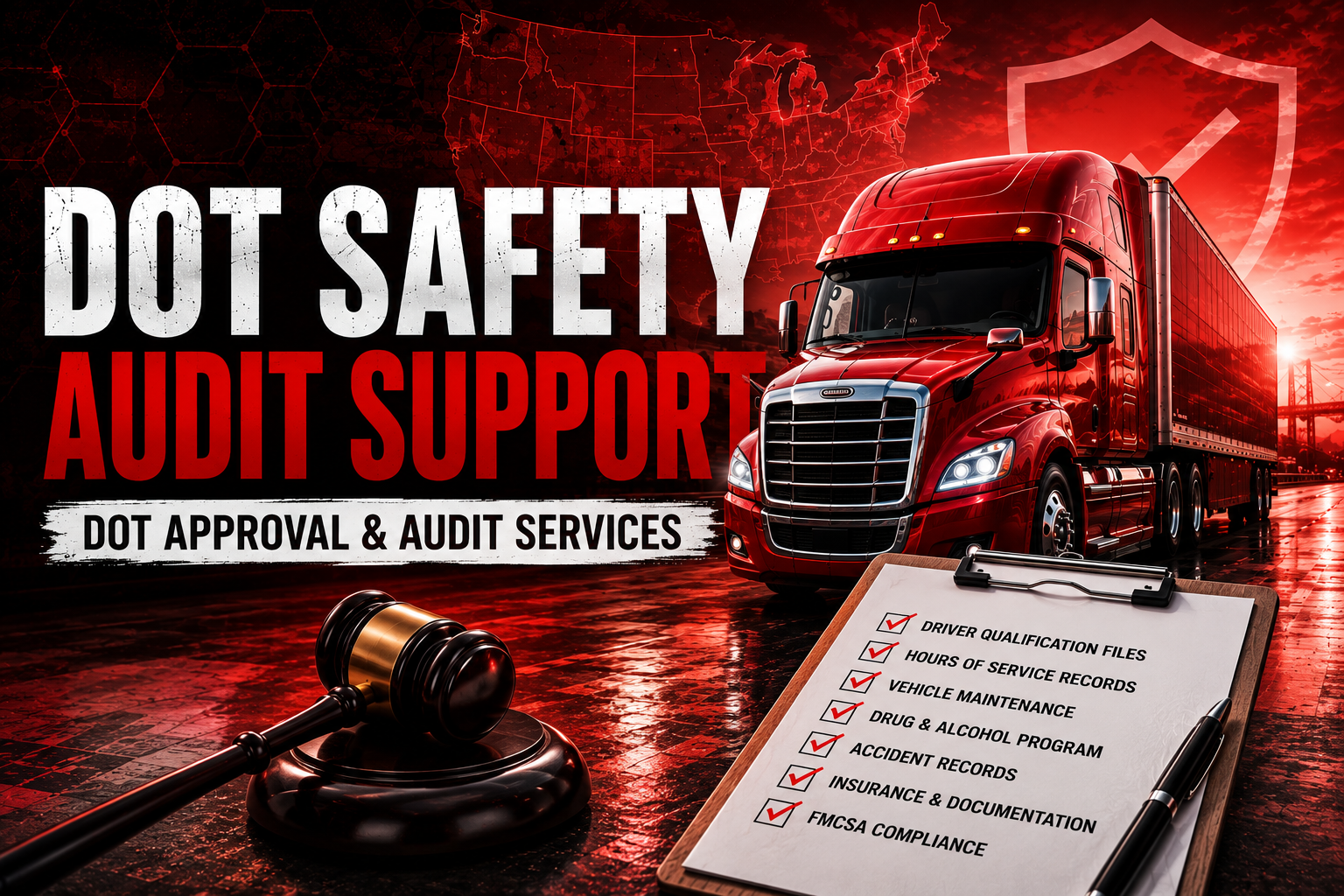
Quick Answer: DOT safety audit preparation generally involves reviewing a motor carrier’s safety-management practices and supporting documentation. Depending on the carrier’s operations, important areas can include driver qualification files, hours-of-service records, vehicle maintenance, accident records, insurance, and drug and alcohol testing requirements. Professional DOT audit support can help a carrier identify missing documentation and organize records before an audit, but no private service provider can guarantee government approval.
What Is a DOT Safety Audit?
The term DOT safety audit is commonly used by trucking businesses when referring to an FMCSA safety audit, particularly one conducted as part of the New Entrant Safety Assurance Program.
A new motor carrier entering interstate commerce may be subject to monitoring and a safety audit as FMCSA evaluates whether the carrier has adequate safety-management controls.
The purpose is not simply to determine whether a company possesses a USDOT number.
Instead, the review may evaluate whether the carrier has established processes and records demonstrating compliance with applicable Federal Motor Carrier Safety Regulations (FMCSRs) and, when applicable, Hazardous Materials Regulations.
The exact requirements depend on the type of operation.
For example, requirements can differ for:
- Property carriers
- Passenger carriers
- Hazmat carriers
- CDL and non-CDL operations
- Interstate and intrastate operations
- Different vehicle types and weights
This is why audit preparation should be based on the carrier’s actual operations rather than a generic checklist downloaded from the internet.
DOT Audit Support: What Does It Mean?
DOT audit support refers to professional assistance that helps a motor carrier prepare its records, processes, and compliance documentation for a DOT or FMCSA safety review.
The objective should not be to manufacture paperwork shortly before an audit. Effective support focuses on determining whether required safety-management systems actually exist and whether the supporting records are complete and properly maintained.
DOT audit support may involve:
- Reviewing carrier information
- Organizing compliance records
- Reviewing driver files
- Identifying missing documents
- Reviewing hours-of-service documentation
- Checking maintenance records
- Reviewing drug and alcohol program documentation where applicable
- Organizing accident-related records
- Preparing an audit-document checklist
- Explaining common compliance requirements
The carrier remains responsible for complying with applicable regulations and providing accurate information.
What Does “DOT Approval” Mean?
DOT approval is a broad phrase frequently used by trucking businesses, but it can be misleading.
There isn’t one universal private-service-provider-issued “DOT approval” that automatically makes every trucking company compliant.
Depending on the situation, a carrier may need various registrations, authorities, filings, insurance, and compliance processes before or after beginning operations.
These can include:
- USDOT registration
- Operating authority, when required
- BOC-3 filing
- Appropriate insurance filings
- Unified Carrier Registration (UCR)
- IRP and IFTA, when applicable
- Drug and alcohol testing program compliance, when applicable
- Driver qualification documentation
- Hours-of-service compliance
- Vehicle inspection and maintenance records
A carrier subject to the New Entrant program may also need to successfully complete the applicable safety-audit process.
Therefore, trucking companies should treat DOT approval as a process involving multiple regulatory responsibilities rather than a single certificate.
Why Is the DOT Safety Audit Important?
A safety audit gives regulators an opportunity to evaluate whether a new carrier has adequate safety-management controls.
It is therefore important to establish compliance processes from the beginning of operations.
Waiting until an audit notice arrives can create problems.
For example, a company may discover that it has:
- Missing driver documents
- Incomplete maintenance records
- Inadequate hours-of-service records
- Missing inspection documentation
- Incorrect company information
- Incomplete drug-testing documentation
- Poorly organized accident records
Reconstructing months of documentation shortly before an audit can be difficult.
A better strategy is to establish an organized compliance system from day one.
Key Areas to Review Before a DOT Safety Audit
Although the exact scope varies, several areas deserve particular attention.
1. Driver Qualification Files
Carriers should determine which driver qualification requirements apply to their operation and maintain the appropriate records.
Depending on applicable requirements, a Driver Qualification File may contain documentation associated with:
- Driver applications
- Motor vehicle records
- Licensing
- Medical qualification
- Prior-employer inquiries
- Annual reviews or related documentation where required
- Other qualification records
Records should be accurate and maintained according to applicable retention requirements.
2. Hours-of-Service Compliance
Hours-of-service rules are intended to address driver fatigue and establish limits for driving and on-duty time.
Depending on the operation, carriers may need to maintain records such as:
- Electronic Logging Device (ELD) data
- Records of duty status
- Supporting documents
- Time records for eligible short-haul operations
Carriers should understand which HOS requirements and exemptions apply to their specific operations.
3. Drug and Alcohol Testing Compliance
Carriers employing drivers subject to DOT drug and alcohol testing requirements need an appropriate testing program.
Compliance can involve areas such as:
- Pre-employment testing
- Random testing
- Post-accident testing when required
- Reasonable-suspicion testing
- Return-to-duty requirements
- Follow-up testing
- Clearinghouse-related responsibilities where applicable
Simply telling a driver to obtain a drug test does not necessarily establish a compliant company testing program.
4. Vehicle Inspection, Repair and Maintenance
Commercial vehicles need to be systematically inspected, repaired, and maintained when applicable under federal regulations.
Carriers should maintain appropriate documentation demonstrating that vehicles are being kept in safe operating condition.
Records may relate to:
- Preventive maintenance
- Repairs
- Periodic inspections
- Vehicle identification
- Inspection documentation
- Defects and corrective actions
Poor maintenance documentation can create compliance problems even when the equipment appears to be operating normally.
5. Accident Records
Motor carriers should understand federal accident-recordkeeping requirements and maintain applicable information.
Good recordkeeping makes it easier to respond when safety information is requested.
Accident documentation should be kept organized separately rather than scattered among dispatch, insurance, and driver records.
6. Insurance and Operating Authority
Carriers should verify that required insurance filings and operating authority information accurately reflect their operations.
Common issues can arise when a business changes:
- Legal name
- Address
- Ownership structure
- Type of operation
- Vehicles
- Insurance providers
FMCSA information should remain accurate when updates are required.
Common DOT Safety Audit Mistakes
Many compliance problems are caused not by one major event but by several smaller administrative failures.
Common examples include:
Incomplete Driver Files: Hiring a qualified driver does not eliminate the carrier’s recordkeeping responsibilities.
Poor Maintenance Documentation: A truck may be maintained regularly, but if the business cannot produce appropriate records, demonstrating compliance becomes more difficult.
Waiting Until the Audit Notice: Compliance systems should exist throughout operations, not only when an audit is approaching.
Misunderstanding Drug-Testing Rules: DOT testing requirements can differ from ordinary workplace drug testing.
Incorrect FMCSA Information: Outdated addresses, contact information, or operational details can cause administrative complications.
Using Generic Templates Without Understanding Them: A downloaded compliance document is useful only when it accurately reflects the carrier’s real operation and applicable requirements.
What Do Professional DOT Audit Services Include?
Professional DOT audit services can help carriers evaluate their documentation before an official review.
A useful audit-support process might begin with a compliance assessment.
Step 1: Review the Carrier’s Operation
Determine:
- What vehicles are operated?
- Are drivers CDL holders?
- Is the company interstate?
- What freight is transported?
- Is hazardous material involved?
- What authority does the company hold?
These answers influence which regulations apply.
Step 2: Review Existing Records
Documents can then be checked for completeness and organization.
Step 3: Identify Compliance Gaps
Missing or incomplete records can be identified before they become larger issues.
Step 4: Organize Documentation
Records can be separated into logical categories so they can be retrieved efficiently when legitimately requested.
Step 5: Establish Ongoing Processes
The most valuable outcome isn’t simply preparing for one audit. It is creating a repeatable compliance process that continues after the audit.
DOT Audit Support vs. Last-Minute Audit Preparation
There is an important distinction between the two.
Last-minute preparation asks:
“What documents do we need to produce for this audit?”
Effective DOT audit support asks:
“Do our safety-management processes meet applicable requirements, and can our records demonstrate that?”
The second approach is much stronger.
A carrier should ideally conduct periodic internal reviews instead of waiting for government correspondence.
Can DOT Audit Services Guarantee Approval?
No legitimate compliance provider should guarantee that a trucking company will pass a government audit or receive a particular regulatory outcome.
FMCSA—not a private consultant—determines the outcome of an FMCSA safety audit.
A professional service can help a carrier:
- Understand applicable requirements
- Review existing documentation
- Identify potential gaps
- Organize records
- Improve compliance processes
But the carrier is ultimately responsible for its operations and regulatory compliance.
Be cautious of advertisements promising “100% guaranteed DOT approval” or a guaranteed audit pass.
Who May Need DOT Audit Support?
Audit-preparation services can be particularly useful for:
New Owner-Operators
New entrants may understand trucking operations well but be unfamiliar with federal recordkeeping requirements.
Newly Established Motor Carriers
A new authority brings additional administrative and safety responsibilities.
Growing Fleets
Adding trucks and drivers increases the volume of documentation that must be managed.
Carriers With Disorganized Records
Even a compliant operation can struggle during a review if records cannot be located efficiently.
Businesses Expanding Interstate Operations
Changes in operations may introduce additional regulatory requirements.
Build a Compliance System, Not Just an Audit Folder
The strongest approach to a DOT safety audit is to treat compliance as an ongoing business function.
A practical compliance calendar can include recurring reviews of:
- Driver qualification documents
- CDL and medical-document status
- Vehicle inspections
- Maintenance schedules
- Hours-of-service records
- Drug and alcohol program requirements
- FMCSA information
- Insurance
- Permits and registrations
This turns audit preparation into routine business administration instead of an emergency project.
How JST Truck Permits Can Help
JST Truck Permits supports owner-operators, new trucking businesses, and established fleets with trucking registration, permit, and compliance-related services.
Depending on your operational needs, assistance may include areas such as:
- DOT audit preparation support
- FMCSA registration assistance
- USDOT registration and updates
- MC Authority services
- Driver Qualification File support
- DOT drug-testing compliance support
- IRP registration
- IFTA registration
- UCR registration
- Truck permits
- Fleet permit management
- New trucking company setup
The goal of professional DOT audit support should be to make compliance requirements easier to understand and help businesses maintain accurate, organized documentation—not simply prepare paperwork at the last minute.
Frequently Asked Questions
What is a DOT safety audit?
A DOT safety audit generally refers to a regulatory review of a motor carrier’s safety-management practices and records. New interstate carriers subject to FMCSA’s New Entrant program may undergo a safety audit.
When does a new trucking company receive a safety audit?
The timing depends on the carrier and applicable FMCSA procedures. New entrants should prepare from the beginning of operations rather than waiting for an audit notice.
What documents are needed for a DOT safety audit?
Required documents depend on the carrier’s operations. Relevant areas may include driver qualification, hours of service, maintenance, accidents, insurance, and drug and alcohol testing.
Can I prepare for a DOT audit myself?
Yes. A carrier can manage its own compliance program. Professional assistance may be useful when regulations are unclear, documentation is incomplete, or the business wants an independent review.
What are DOT audit services?
DOT audit services generally help motor carriers review applicable compliance requirements, evaluate documentation, identify gaps, and organize records before a regulatory review.
Does passing an audit mean I’m permanently compliant?
No. Compliance is ongoing. Carriers must continue meeting applicable federal and state requirements after an audit.
Final Thoughts
A DOT safety audit should not be treated as a one-time paperwork exercise. It is an opportunity to demonstrate that your trucking company has effective safety-management controls and understands its regulatory responsibilities.
Preparing early, maintaining accurate records, monitoring driver and vehicle documentation, and periodically reviewing your compliance systems can make the process significantly easier.
Professional DOT audit support can provide additional guidance when a carrier needs help understanding requirements or organizing records. However, trucking businesses should remember that DOT approval and official audit outcomes are determined by the appropriate government agencies—not private compliance companies.
For trucking businesses, the best strategy is simple: build compliance into everyday operations so you’re prepared before an audit notice arrives.