FMCSA Carrier Registration Maintenance: USDOT, MC Authority & Safety Updates Explained
Maintaining accurate FMCSA carrier registration information is an ongoing responsibility for motor carriers operating in the United States. Getting a USDOT Number or operating authority is only the beginning. As a trucking company changes, its registration records may also need to change.
A new business address, legal business name, fleet size, operating classification, contact information, or authority status can create a reason to review your FMCSA records.
FMCSA also requires entities under its jurisdiction to complete a biennial update every two years, even when their company information has not changed.
For trucking companies, this means registration maintenance should be treated as a regular business process rather than something addressed only when a problem occurs.
This guide explains FMCSA carrier registration, FMCSA safety registration, FMCSA authority update, FMCSA MC number update, and FMCSA USDOT update requirements and how carriers can keep their records organized.
Quick Answer: What Is FMCSA Carrier Registration Maintenance?
FMCSA carrier registration maintenance is the process of keeping a motor carrier’s USDOT registration, operating authority, company information, and related FMCSA records accurate and current.
This may involve:
- Completing required biennial updates
- Updating company addresses
- Changing business information
- Updating fleet and vehicle information
- Reviewing operation classifications
- Updating operating authority information
- Reinstating authority when applicable
- Correcting outdated carrier records
- Keeping safety-related registration information accurate
A carrier should not assume that information submitted when the business was first established will remain accurate indefinitely.
What Is FMCSA Carrier Registration?
FMCSA carrier registration refers to registration information maintained with the Federal Motor Carrier Safety Administration for motor carriers and other regulated entities.
Depending on the business and its operations, FMCSA registration may involve a USDOT Number, operating authority, and other applicable registrations.
A USDOT Number serves as an identifier for applicable companies involved in commercial transportation.
Operating authority is different.
Certain for-hire interstate carriers and other regulated businesses may need specific operating authority in addition to a USDOT Number.
This distinction is important because:
USDOT registration and operating authority are not the same thing.
A carrier may have a USDOT Number but still require operating authority depending on the type of transportation it performs.
Why Does FMCSA Carrier Registration Need Maintenance?
Trucking businesses change.
A company may:
- Move to a different address
- Add trucks
- Remove vehicles
- Change its legal business name
- Modify the type of cargo it transports
- Change operating classifications
- Expand its services
- Modify authority
- Temporarily stop operating
- Return to operations
When relevant company information changes, FMCSA records should be reviewed and updated as required.
Accurate registration information helps create consistency between the carrier’s actual operation and its federal records.
This is particularly important because FMCSA registration information can interact with other safety, compliance, and operating records.
What Is an FMCSA USDOT Update?
An FMCSA USDOT update is a change or required update to information associated with an existing USDOT Number.
FMCSA requires entities under its jurisdiction to update their information every two years.
This is known as the biennial update.
Importantly, the biennial update is required even when the company’s information has not changed.
Carriers may also need to update information between biennial filing periods when important company information changes.
Examples can include changes involving:
- Physical address
- Mailing address
- Contact information
- Number of power units
- Driver information
- Cargo classifications
- Type of operation
- Other registration information
Maintaining accurate USDOT information should therefore be considered an ongoing compliance responsibility.
What Is the FMCSA Biennial Update?
The FMCSA biennial update is the required two-year update of a regulated entity’s USDOT registration information.
The filing schedule is based on the final digits of the USDOT Number.
The last digit determines the filing month:
| USDOT Number Ends In |
Filing Month |
| 1 |
January |
| 2 |
February |
| 3 |
March |
| 4 |
April |
| 5 |
May |
| 6 |
June |
| 7 |
July |
| 8 |
August |
| 9 |
September |
| 0 |
October |
The next-to-last digit determines the filing year.
If that digit is odd, the update is generally due in an odd-numbered calendar year.
If it is even, the update is generally due in an even-numbered calendar year.
Example
Suppose a USDOT Number ends in 72.
The final digit is 2, which corresponds to February.
The next-to-last digit is 7, an odd number.
Therefore, the carrier’s regular biennial filing schedule would fall in February of an odd-numbered year.
This makes it possible for carriers to determine their filing cycle directly from their USDOT Number.
Do You Need an FMCSA USDOT Update If Nothing Changed?
Yes.
This is one of the most important points for motor carriers to understand.
FMCSA requires entities under its jurisdiction to complete their biennial update even if their information has not changed.
Carriers should therefore not assume:
“Nothing changed, so I don’t need to file.”
The biennial filing requirement still applies.
Failing to complete a required update can affect the status of a USDOT Number and may result in enforcement consequences.
What Information Should Carriers Review During an FMCSA USDOT Update?
Before completing an FMCSA USDOT update, review your entire carrier profile rather than changing only one field.
Check:
Business Information
Confirm the company’s legal business name, DBA information where applicable, physical address, mailing address, and contact details.
Operating Classification
Make sure the classifications accurately represent how the company currently operates.
Cargo Information
Review the cargo categories associated with the operation.
Fleet Information
Check information concerning power units, trailers, and other applicable fleet details.
Driver Information
Make sure applicable driver information accurately reflects the operation.
Mileage Information
Review reported mileage or Vehicle Miles Travelled information where applicable.
An accurate registration record should represent the carrier’s current operation as closely as possible.
Why Fleet and Mileage Information Matters
Motor carriers sometimes focus on their business name and address while overlooking fleet and mileage information.
That can be a mistake.
FMCSA’s Compliance, Safety, Accountability resources explain that Safety Measurement System calculations use information including Vehicle Miles Traveled and power-unit data.
FMCSA encourages carriers to update MCS-150 information when data changes rather than treating the two-year filing cycle as the only opportunity to update records.
For a rapidly growing trucking company, this can be especially relevant.
A carrier that grows from two trucks to twenty trucks has experienced a significant operational change. Its registration data should accurately reflect its current operation when an update is required or appropriate.
What Is an FMCSA Authority Update?
An FMCSA authority update involves changes related to a carrier’s federal operating authority.
Operating authority is commonly associated with docket numbers using prefixes such as:
Depending on the carrier’s situation, authority-related actions may include:
- Address changes
- Legal name changes
- Applying for additional authority
- Reinstatement
- Revocation-related actions
- Voluntary suspension where available
- Changes associated with the carrier’s operating structure
Carriers should understand that updating their USDOT information does not necessarily mean every operating-authority record has automatically been addressed.
When business information changes, review both registration and authority records.
What Is an FMCSA MC Number Update?
The phrase FMCSA MC number update is commonly used by carriers searching for help changing information connected with their motor carrier operating authority.
An MC Number is a docket number historically associated with certain types of FMCSA operating authority.
An update may be relevant when a carrier:
- Changes its business address
- Changes its legal name
- Needs additional authority
- Needs authority reinstatement
- Changes aspects of its business structure
- Needs to review authority status
However, carriers should distinguish between changing information associated with existing authority and obtaining a completely new authority.
The appropriate process depends on the specific change.
Important 2026 Change: FMCSA Motus Registration System
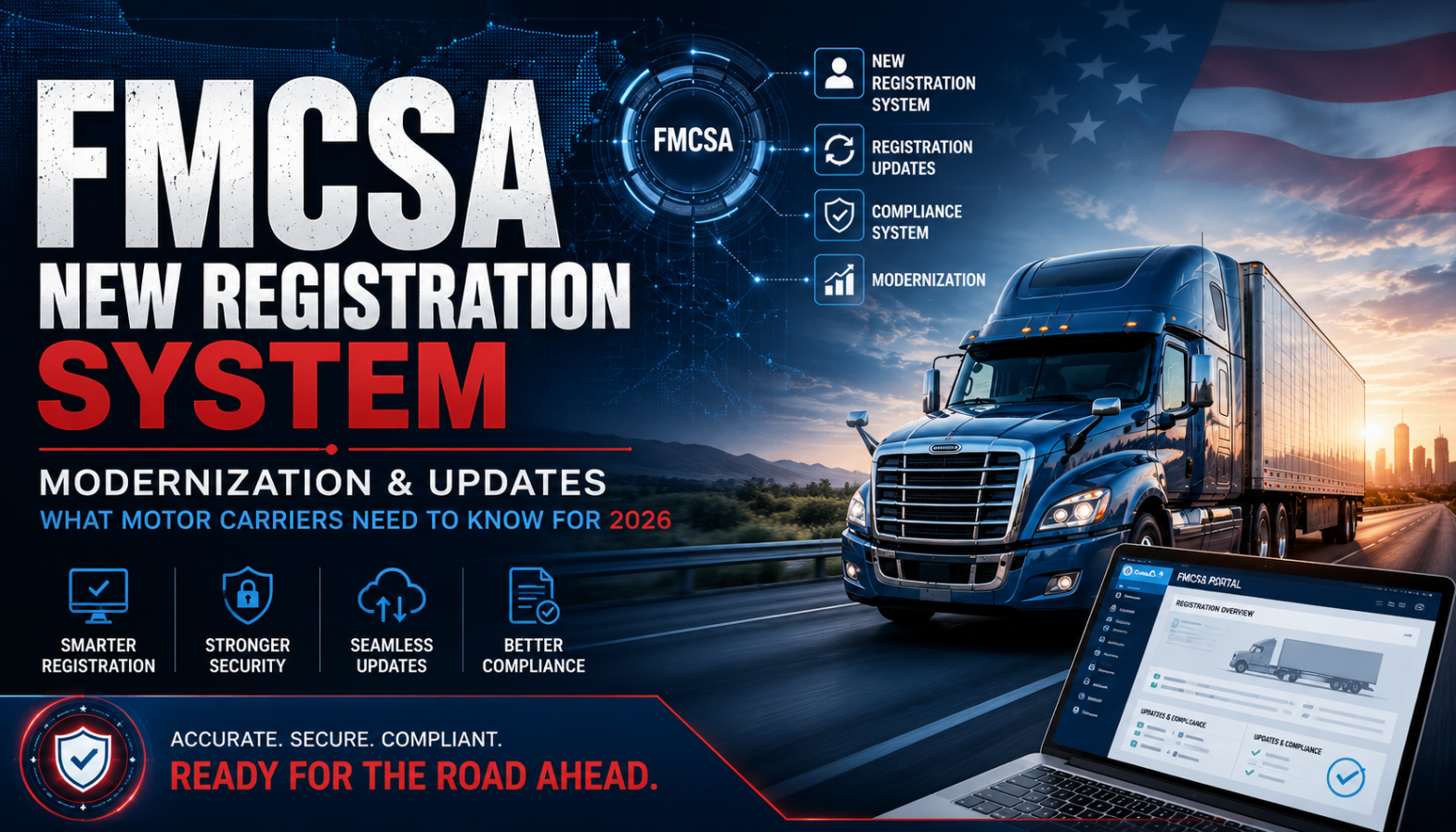
FMCSA registration underwent a significant modernization in 2026 with the introduction of Motus: USDOT Registration System.
Motus is designed as a centralized system for FMCSA registration activities and introduces new tools for managing registration information, improving data validation, and strengthening fraud prevention.
For carriers, this means older tutorials describing only legacy FMCSA registration systems may no longer accurately represent the current process.
Motus is designed to support the registration lifecycle, including registration management and authorized access.
This makes it particularly important for trucking companies to rely on current FMCSA guidance when making registration changes.
Did Existing USDOT and MC Numbers Change Because of Motus?
No. Existing USDOT Numbers and existing operating-authority docket numbers did not automatically change simply because Motus was introduced.
FMCSA has stated that existing USDOT Numbers and docket numbers remain unchanged.
However, Motus changes how newly issued registration identifiers and authorities can be structured and tracked.
For example, newly issued USDOT Numbers and operating-authority docket numbers are randomized as part of FMCSA’s fraud-prevention efforts.
Motus also provides individual lifecycle tracking for newly granted operating authorities.
This is an important distinction for existing carriers concerned that registration modernization means they need a new USDOT or MC Number.
What Is FMCSA Safety Registration?
FMCSA safety registration can broadly refer to registration information and processes that connect a motor carrier’s identity and operations with FMCSA’s safety oversight framework.
A carrier’s safety responsibilities extend beyond obtaining a registration number.
Depending on the operation, responsibilities may involve:
- Driver qualification
- Hours-of-service compliance
- Vehicle inspection and maintenance
- Drug and alcohol testing
- Accident records
- Safety management
- New Entrant requirements
- Registration accuracy
Registration information should accurately represent the business because carrier data is used throughout FMCSA systems and regulatory processes.
FMCSA Registration vs FMCSA Safety Compliance
These terms are related, but they are not interchangeable.
FMCSA Registration
Registration establishes and maintains information about the regulated entity and applicable operating authority.
FMCSA Safety Compliance
Safety compliance involves the carrier’s ongoing adherence to applicable Federal Motor Carrier Safety Regulations.
A company can have an active USDOT Number and still have separate safety compliance responsibilities.
Likewise, completing a registration update does not replace requirements related to driver qualification, vehicle maintenance, drug and alcohol testing, hours of service, or other applicable regulations.
When Should a Carrier Update FMCSA Information?
A carrier should review whether an update is necessary whenever significant business information changes.
Common triggers include:
1. Business Address Change
If the company moves, review the physical and mailing addresses associated with its registration.
2. Legal Business Name Change
Changing a legal business name can require specific documentation and registration actions.
3. Fleet Expansion
Adding a significant number of vehicles may change fleet information associated with the carrier’s record.
4. Operational Changes
Changing the type of transportation performed may affect registration information.
5. Cargo Changes
Beginning to transport different types of cargo may require updating classifications.
6. Authority Changes
Expanding into operations requiring additional authority may require an authority-related filing.
7. Biennial Update Deadline
Even without other changes, the mandatory two-year filing requirement should be monitored.
FMCSA Carrier Registration Maintenance Checklist
Motor carriers can use this simple checklist as part of an internal registration review.
Company Details
- Verify legal business name
- Verify DBA information
- Confirm physical address
- Confirm mailing address
- Review phone and contact information
USDOT Information
- Check USDOT status
- Determine biennial update deadline
- Review fleet information
- Review driver information
- Check cargo classifications
- Review mileage information
Operating Authority
- Verify authority status
- Review applicable docket numbers
- Confirm company information is consistent
- Determine whether additional authority is needed
Safety & Compliance
- Review driver qualification records
- Review vehicle maintenance documentation
- Review drug and alcohol testing responsibilities
- Review applicable safety requirements
Internal Records
- Record registration deadlines
- Store confirmation documents
- Maintain copies of submissions
- Document changes made to carrier records
A quarterly or semi annual internal review can help businesses identify outdated information before an important deadline.
Common FMCSA Registration Maintenance Mistakes
Waiting Until the Biennial Deadline
The biennial update is a mandatory filing cycle, but carriers should not necessarily wait two years to address important changes.
Assuming a USDOT Update Changes Everything
USDOT registration, operating authority, insurance filings, and other credentials can involve different processes.
Creating a New USDOT Number Instead of Updating an Existing Record
Businesses that already have or previously had a USDOT Number should carefully determine the correct process before attempting another registration.
Ignoring Fleet Changes
Fleet size, driver information, mileage, and cargo classifications can become outdated as a business grows.
Using Outdated FMCSA Tutorials
FMCSA registration changed significantly with Motus in 2026. Instructions written for older registration systems may no longer match current procedures.
Not Keeping Confirmation Records
Save documentation and confirmation information associated with registration submissions.
FMCSA Registration Maintenance for Growing Fleets
Registration maintenance becomes increasingly important as a trucking company expands.
Consider a carrier that begins operations with:
2 trucks → 4 drivers → one operating region
Two years later, the same company may have:
15 trucks → 20 drivers → multiple operating regions → additional cargo types
The company’s federal registration data should evolve with its actual operation.
Creating a centralized compliance calendar can help track:
- FMCSA registration reviews
- Biennial updates
- Authority status
- UCR
- IRP renewals
- IFTA responsibilities
- Insurance-related deadlines
- Drug-testing program responsibilities
- Driver qualification reviews
This turns compliance from a reactive task into a repeatable business process.
How to Check Your Current FMCSA Carrier Information
Before making an update, carriers should first review the information currently associated with their business.
FMCSA provides carrier information through its official systems, including the SAFER Company Snapshot for reviewing USDOT-related company information.
Compare the public record against your current operation.
Look for inconsistencies involving:
- Company name
- Address
- USDOT status
- Operating status
- Power units
- Drivers
- Mileage
- Cargo classifications
- Authority information
If information is incorrect or outdated, determine which FMCSA registration action applies.
How JST Truck Permits Helps With FMCSA Registration Updates
Managing a trucking company already involves dispatch, customers, equipment, drivers, accounting, insurance, and day-to-day operations.
Registration paperwork adds another administrative responsibility.
JST Truck Permits helps owner-operators, new motor carriers, and established fleets navigate trucking registration, permit, and compliance-related processes.
Services can include assistance with:
- FMCSA carrier registration
- FMCSA USDOT update
- FMCSA authority update
- FMCSA MC number update
- USDOT registration
- Operating authority
- New trucking company setup
- IRP registration
- IFTA registration
- UCR
- Temporary trip permits
- Truck title transfers
- DOT drug testing
- DOT compliance support
- Fleet permit management
Professional assistance can be particularly useful when a business has changed substantially since its original registration or when multiple records need to be reviewed.
Frequently Asked Questions About FMCSA Carrier Registration
How often must FMCSA registration be updated?
Entities under FMCSA jurisdiction generally must complete their USDOT information update every two years according to the applicable biennial filing schedule. Carriers should also review whether updates are needed when business information changes.
Do I need an FMCSA USDOT update if nothing changed?
Yes. The required biennial update still applies even when the carrier’s information has not changed.
Is an MC Number the same as a USDOT Number?
No. A USDOT Number identifies applicable regulated entities, while an MC Number is a docket number associated with certain operating authorities. Depending on its operation, a carrier may have both.
Does changing my address require an FMCSA update?
A change to a motor carrier’s address should be reflected in applicable FMCSA registration and authority records.
Do I need a new USDOT Number when my information changes?
Generally, an existing carrier should determine the appropriate update process rather than simply applying for another USDOT Number. FMCSA specifically provides procedures for updating existing registrations.
What is an FMCSA authority update?
An FMCSA authority update involves changing or managing information associated with operating authority, such as certain address or name changes, additional authority, reinstatement, or other applicable authority actions.
What is an FMCSA MC number update?
FMCSA MC number update is a commonly searched term referring to updates associated with a carrier’s operating-authority record. The required procedure depends on exactly what information or authority status needs to change.
What happens if I miss my biennial update?
Failure to complete the required biennial update can result in USDOT Number deactivation and may expose the carrier to civil penalties under applicable FMCSA rules.
What is Motus?
Motus is USDOT’s modern FMCSA registration system. It is designed to centralize registration activities, improve data validation, strengthen security, and make registration management easier for regulated entities.
Did Motus replace existing USDOT Numbers?
No. Existing USDOT Numbers and existing docket numbers did not automatically change when Motus was introduced.
The Bottom Line
FMCSA carrier registration does not end when a trucking company receives its USDOT Number or operating authority.
Carrier information needs to remain accurate throughout the life of the business.
That means understanding when an FMCSA USDOT update is required, completing mandatory biennial updates, managing an FMCSA authority update when operations change, keeping information associated with an FMCSA MC number update accurate, and understanding how registration information relates to broader FMCSA safety registration and compliance responsibilities.
The simplest approach is to treat registration maintenance as an ongoing process:
Review → Verify → Update → Document → Repeat
A carrier that regularly reviews its information is better positioned to identify outdated records before they become operational or compliance problems.
For owner-operators and fleets that need assistance managing registration and trucking paperwork, JST Truck Permits can help simplify the process and keep important carrier information organized.